
The best place to find street art in Budapest is in the Jewish Quarter. I took a Budapest street art tour to discover all the best art.
When I arrived in Budapest I stayed in the Jewish Quarter, also known as District VII.
It’s one of your typical hipster / gentrified / “used to be dodgy but now very cool” districts, that you find around big cities these days.
As you’d expect, it’s super touristy and full of bars, but as is common in these areas, it’s also full of creativity and street art.
I noticed quite a few large murals while walking around, they are hard to miss. They all looked commissioned and very professional.
What I didn’t notice was that there was a more diverse world of urban art to be discovered in the 7th District.
Table of contents
Taking a street art tour in the Jewish Quarter in Budapest
I wanted to know the stories behind those large, commissioned murals, so I took a street art tour.
Arriving at the meeting point for the tour, our guide Attila from Budapestflow Walking Tours welcomed everyone with a smile and made sure to introduce all the members of the group to each other.
It was a small group tour, there were 8 of us, which for me is just the right size for this kind of tour.
When I travel solo, small group tours are a good way to meet other travellers and sometimes locals too. When your guide creates a super friendly atmosphere right from the start, that’s a great plus point.
After the introduction and a bit of chatting, we started the tour in the 7th District.
Street art in the Jewish Quarter of Budapest
The great murals I had noticed while walking around the Jewish Quarter were some of the highlights of the tour.
A selection of the Budapest street art we saw on the tour

A remarkable artwork not to be missed is a massive Rubik’s Cube.
The Budapest-born inventor of the Rubik’s Cube, Ernő Rubik, still lives in the city to this day.
The mural is really impressive and thanks to some clever 3d optical illusion, what you see on the wall in real life is different to what you see when you take a picture of it.

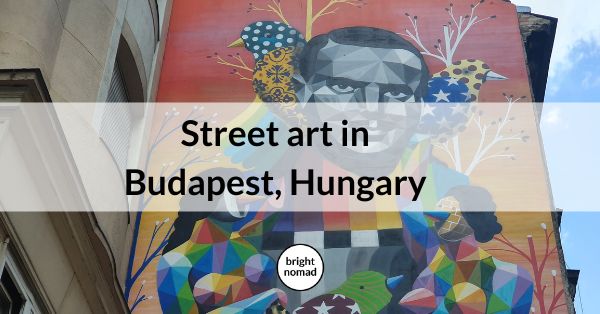
One of the most beautiful murals we saw on the tour was painted by Spanish street artist Okuda. I have seen his vibrant art in other cities too, like Madrid.
It’s superbly colourful and it has an interesting story behind it.
The man in the mural is Angel Sanz Briz, also called “The Angel of Budapest”. He saved more than 5,000 Hungarian Jews during the Holocaust.
The piece was commissioned by the Spanish embassy, as part of an international project, a series of murals called Walls for Freedom. They all depict similar, lesser-known heroes from the WWII era.

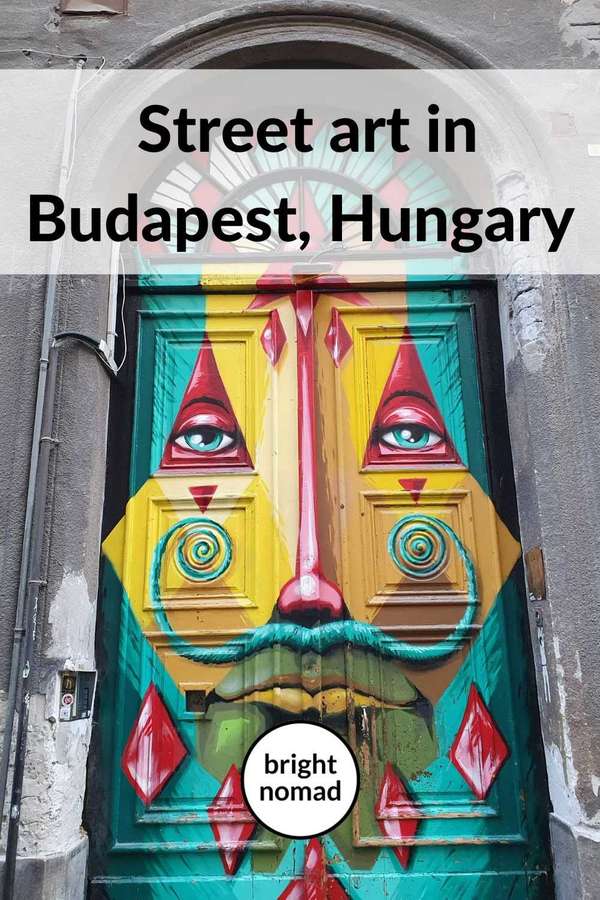
This cheerful door art was painted by Hungarian street artist Void, who creates abstract faces.
I love when street art merges so perfectly with the surface it’s painted on.
During the tour, we also discovered smaller artworks by independent artists, mostly stickers and paste-ups.
You can see tons of these on the Budapestflow Instagram feed.

This taxi mashup is a paste-up by a local artist called Bamamo Budapest.
I must say I could have easily overlooked this paste-up because, in order to understand it, our guide had to unpack the local humour, Hungarian history and cultural references all contained in this one piece.
Putting Budapest street art in context

Street art is often political or has something to say about social issues and current affairs.
On a tour taking place in the now hip Jewish Quarter, you can’t escape discussing both the tragic history of the streets we were walking through and the present concerns about gentrification.
Quite a few of the street art pieces we saw on the tour had some social or political context, local cultural references and hidden meanings to them.
Our guide explained the background with the right amount of detail.
Even if some of us knew very little about Hungarian history or society, it was very easy to follow the stories and understand the art in context.
We learnt about the history of the Jewish ghetto and the more recent history of Jewish life in Budapest.
We also learnt about how the 7th District used to be a run-down area, but in the past 15 years has gone through a huge transformation. Now it is the most popular part of the city for tourism and nightlife.
Join a Budapest street art tour
If you’re planning a visit to Budapest, check availability for street art tours in this calendar:
Street art in Budapest ruin bars
The Jewish Quarter in Budapest is famous for its ruin bars, so these quite naturally became part of the tour.
Szimpla is probably the most well-known ruin bar. It is packed with urban art of all kinds on its walls, ceilings, staircases and just about anywhere else.
We visited Szimpla towards the end of the tour and enjoyed the quirky atmosphere and super creative spaces.
A little earlier, we stopped for drinks at another bar, as part of the tour. We all appreciated the chance to rest our feet and have a cold drink on a hot day.
This stop also gave us a chance to talk to each other more. I really enjoyed the social element of this group tour.
During that break, our guide gave us many local tips for places to eat, drink and visit and answered all our questions about Budapest.
Final reflections on this Budapest street art tour
All in all, the tour was a success, we all left with a smile and with a much better understanding of the local street art scene.
Street art always changes and next time I visit Budapest I hope to see more fresh art on its walls and maybe get to explore street art in other districts too.
More things to do in Budapest
Save this guide to street art in the Jewish Quarter in Budapest on Pinterest
More things to see in Budapest
More street art posts
I was invited by Budapestflow Walking Tours to take part in the tour. All opinions are my own.
1 Comment
Hi Tal, I’m totally shocked! Is this Budapest? It looks almost like any other western city! The synagogue, the Danube, the stunning streets – everything is impressive. And during my visit not many years ago, I was under the impression that the city was gray and boring. It probably takes eyes and observation like yours to see that. Thank you very much for this very interesting post.