

In this guide I share a route for a Porto old town self-guided walk, from the city centre through the city’s historic part to the waterfront.
On my last trip to Porto, I took a walk in the beautiful old town all the way to the banks of the Douro River.
This Porto old town self-guided walk follows a downhill route that connects viewpoints, historic buildings, and some of Porto’s most atmospheric streets.
Get an offline map of this Porto old town self-guided walk
This article is also featured on GPSmyCity. To download this article for offline reading or create a self-guided walking tour to visit the attractions highlighted in this article, go to Walking Tours and Articles in Porto.
Table of contents
The Porto old town self-guided walk route
The Portuguese Centre of Photography and Largo Amor de Perdição
The tour starts in the city centre, uphill from Ribeira (the waterfront). We’ll gradually head down to the river.
Begin at Largo Amor de Perdição, a small square in front of what used to be a prison and is now the Portuguese Centre of Photography.
The square’s unusual name, Amor de Perdição (love of perdition), comes from a famous novel by Portuguese writer Camilo Castelo Branco, who was imprisoned here.
I liked the contrast between the austere stone façade and the modern use of the space. It’s worth going inside, especially if you like photography exhibitions, or just to see the interior of the prison.
Virtudes Park viewpoint – Passeio das Virtudes

Walk about 5 minutes down Rua Das Taipas towards Passeio das Virtudes.
It’s in Virtudes Park, a lovely terraced garden.
This park sits on the hillside overlooking the Douro River. It offers a pretty dramatic scenery worth pausing for.
You’ll see the park, red rooftops, the river, the bridge and the other side of the river.
From there head down to Belomonte Street.
Belomonte Street
Take a slow walk in the historic Belomonte Street (Rua de Belomonte), a narrow, characterful street that winds downhill.
This area was historically home to artisans and merchants. It’s a less polished side of Porto, but more authentic, with layers of history.
Some spots to pay attention to on this street:
The Porto Puppet Museum (Museu das Marionetas). Keep an eye out for the distinct red doors next to it, that mark the entrance to the theatre (Teatro de Belomonte) and museum.
Palácio de Belomonte, a beautiful historic building, originally a home for an aristocratic family. The street is so narrow you have to cross it to get a full view.
The family-run brush shop called Escovaria de Belomonte has been operating for nearly a century.
Like the famous Lello Bookshop in Porto, it is thought to have inspired potter but we cannot know if it’s true.
There are some small bars and eateries along this street.
Ferreira Borges Market

Now we’re starting to get closer to the river.
From Belomonte walk down Rua de Ferreira Borges and you’ll soon see a large red building to your left.
Ferreira Borges Market is an iron-and-glass building dating from the late 19th century. Its industrial-era architecture looks quite unusual among the other buildings in this part of the city.
It’s also quite different from what you might expect from a traditional market.
Originally a food market, it now houses cultural events, like art exhibitions, concerts, design fairs, and occasional pop-up events.
When I was there there was a pop-up design market, so I stepped inside to have a look.
Bolsa Palace (Palácio da Bolsa)
A little farther downhill is Bolsa Palace, the former Porto stock exchange.
The building’s scale and grandeur hint at the city’s historic commercial power.
It was built in the 19th century and took several decades to complete.
The palace is especially famous for its Arab Room, inspired by Moorish architecture.
To see inside the palace, you’ll have to take a 30 minute guided tour, which you need to reserve online in advance.
In the evenings, this beautiful space turns into a music venue with the Candlelight concert series.
The Monument to Prince Henry the Navigator
Opposite Bolsa Palace you’ll see the Monument to Prince Henry the Navigator (Monumento ao Infante Dom Henrique) in the middle of the square.
He was a 15th-century Portuguese prince who played a central role in the early Age of Exploration and in establishing Portugal as a leading maritime power.
He’s celebrated for that, but this is a controversial figure, because those explorations were connected with the early Atlantic slave trade and European colonialism.
São Francisco Church

Around the corner from Bolsa Palace, you’ll see São Francisco Church (Church of Saint Francis).
It looks fairly modest on the outside, but is lavish and full of gold leaf decorations on the inside.
You can enter to see the interior, or head down to the waterfront.
Ribeira Square (Praça da Ribeira)

From São Francisco Church head down to the river and turn left.
You’ll pass through Cais da Estiva and then reach Ribeira Square.
This is the iconic Porto riverside scene you’ve seen in postcards.
You get perfect views from the square across the river.
I liked the colourful buildings and street musicians. It’s very lively.
Porto’s Ribeira is super popular with tourists and full of places to eat and drink. Some may be overpriced, as it’s such a touristy place.
Rua Nova da Alfândega

From there, walk back for about 10 minutes to reach Rua Nova da Alfândega.
The street runs parallel to the Douro River .
Historically, this street was linked to trade and customs, connecting warehouses, merchants and the river port.
Today, it’s a mix of old houses, museums, offices, cafés, with wide pavements, some great street art murals, and views towards the Douro.
You can take lovely photos of colourful houses up the hill from the street level.
While you walk along this street, you’ll see the historic tram line 1 that runs along it, following the Douro riverfront between central Porto and Foz do Douro.
At some point you’ll reach a large and rather imposing building. This is Alfândega do Porto which was the old Customs House. These days it’s home to:
- Porto Legends
- Living Van Gogh Porto
- Museum of Transport and Communication
- World of Discoveries across the road from Alfândega do Porto.
Porto old town self-guided walk tips
- The route works best from top to bottom (going downhill).
- The difficulty level is easy to moderate, as it’s mostly downhill, but there are some cobbles and steps.
- You can complete this route in under 2 hours, but I would allow extra time for viewpoints, cafes, taking pictures, and going inside some of the buildings.
- Cobblestones can be slippery and are sometimes uneven. It’s an issue I encountered in other places in Portugal too. Take extra care.
- Since you’ll be out in the sun for a while, keep water on hand to stay hydrated and wear polarized sunglasses to reduce glare. A hat and sunscreen are also great ways to protect yourself from the sun while enjoying the walk.
My experience taking the Porto old town self-guided walk
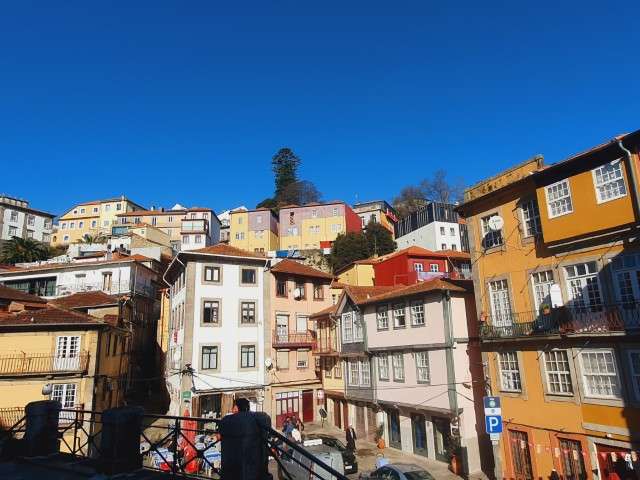
This Porto old town self-guided walk was a lovely experience.
I enjoyed this route because of the variety of things to see along the way. One moment you’re in a narrow street with artisan shops that still feels almost untouched by modernity, and by the end of the tour you’re in the lively waterfront.
All along the route I spotted the old Portuguese tile panels (Azulejo) and stopped to take pictures of those addictive patterns.
The viewpoints overlooking the river are beautiful. I loved the reflections on the water and the Rabelo boats moored along the river.
All in all, it’s an easy walk with a lot of local and historic charm.
Browse other Porto guides
Save this Porto old town self-guided walk on Pinterest


9 Comments
I love discovering a new city by walking! Porto is such an amazing place and this is a great guide to get a feel for it.
There’s no better way to experience a new location than on a self guided walk. It lets you wander at your own pace, soak in the atmosphere, and notice the little details that make a place truly memorable.
We loved Porto! Such a colourful city – this is a great way to see it!
Porto’s old town is wonderful to explore on foot. I took a language class just around the corner from Mercado do Bolhão, so had the opportunity to spend afternoons ambling through old town. Highly recommend this.
I love how this walk shows different sides of Porto — from quiet historic streets to the lively Ribeira by the Douro. Thank you for sharing such a thoughtful route.
I love this! Porto is one of those cities where you really need a map so you don’t miss the hidden gems tucked away in the alleyways. Your walking tour hits all the high notes while keeping it manageable. Thanks for sharing such a practical guide!
Porto’s old town looks like such a joy to explore on foot. A self-guided walk is a lovely way to move at your own pace, stop for a bite to eat, and really take in the history woven through those narrow streets and tiled façades. A helpful guide.
There is no better way to discover a city or town by putting your walking shoes on and getting walking!
I feel like walking the streets of Porto with you. I like that you put the walking distance and places to see or skip within 2 hours.