
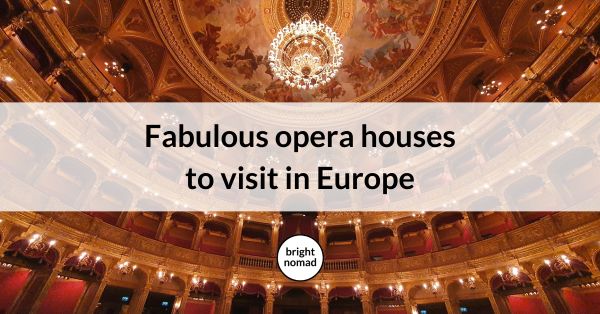
There are some truly beautiful opera houses in Europe. I’ve visited a few of them and selected my top 3 that you can visit too.
I’ve learnt a lot by taking tours at opera houses in Europe.
Opera houses aren’t just venues. The have fascinating background stories, plus gorgeous architecture designed to impress.
That’s why you don’t have to be an opera fan to enjoy touring opera houses. Seeing them from the inside is a unique experience.
I created this guide about opera houses in Europe that are worth a visit for those who love opera or are curious about opera, plus anyone interested in architecture, drama, and history.
Table of contents
My top 3 opera houses in Europe
Palais Garnier, Paris

If you only ever visit one opera house in your life, make it this one. Palais Garnier redefines grandeur.
From the outside, you see an absurdly extravagant facade that rises up at the end of Boulevard Haussmann.
But the moment you step inside, you realise the exterior was just the warm-up.
The grand staircase alone is worth the trip.
White marble, branching in two directions, designed not just to get you from one floor to another but to let you be seen doing it.
Up in the auditorium, look at the ceiling. What you’re seeing is Marc Chagall’s 1964 painting, a swirl of colour depicting scenes from fourteen operas and ballets, suspended above a chandelier that weighs roughly six tonnes.
How to visit Palais Garnier
You can see Palais Garnier either on a guided tour or on a self-guided tour.
I visited on a weekday on a self-guided tour.
There were quite a lot of people around the building, but it didn’t feel crowded.
I had time to stand still and take things in, explore at my own pace, and take a lot of pictures.
If you want the full picture of what the tour covers and what to expect, I’ve written about it in more detail in my full review of Palais Garnier.
Vienna State Opera
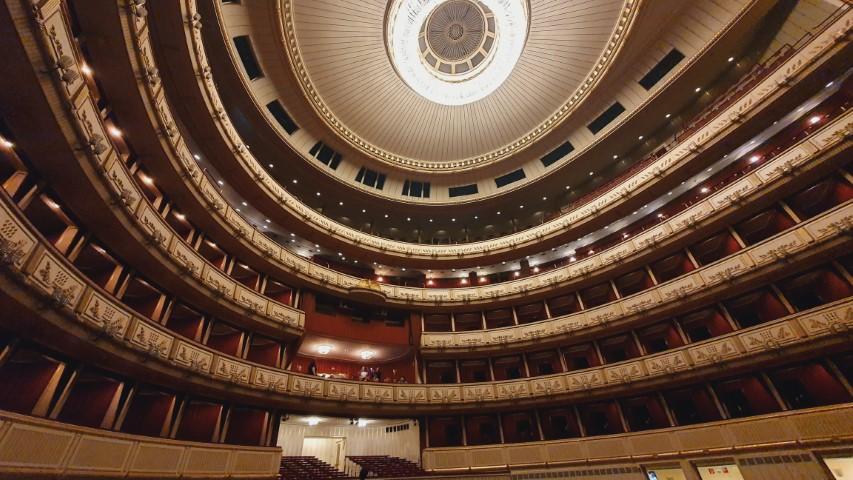
Opera is taken seriously in Vienna.
The Vienna State Opera (Wiener Staatsoper) sits on the Ringstrasse, Vienna’s grand ceremonial boulevard, close to all the other important attractions in the city centre. You can’t miss it.
From the outside I felt the building was quite imposing with its Renaissance Revival architecture.
Inside, the beautifully decorated interiors have a complicated history.
The original building was badly damaged in the final days of the Second World War, and what you see today is partly a faithful reconstruction, partly a re-imagining.
Some of the most historically significant spaces survived intact, including the main staircase and the amazing tea room.
How to visit the Vienna State Opera
I saw the building from the inside first when I went to see an opera performance.
Then I saw it a second time (on a different trip to Vienna) when I took the official guided tour of the building.
If you love opera, I recommend both.
The tour was included in my Vienna Pass.
You can also book it directly without the Vienna Pass from the official site, where you’ll also find show tickets.
Taking the guided tour gave me better insight into the history of the building. I had no idea about its wartime history on my first visit.
The tour guide also told us about the different architectural styles, local traditions related to the opera, and even about how the stage works.
If you want to know exactly what the tour covers and how to make the most of it, read my full review of the Vienna opera tour.
Another option is to see a classical music concert inside the opera house.
Hungarian State Opera, Budapest

The Budapest opera house isn’t quite as famous as the other two, and certainly far less crowded.
I think too many tourists might miss it when they visit the city. For me, it was a wonderful discovery.
The Hungarian State Opera is centrally located on Andrássy út, a grand tree-lined boulevard that feels like Budapest’s answer to the Ringstrasse.
I found it very impressive from the outside, but when I stepped inside, the interior was one of the most ornate I’d seen anywhere.
Frescoed ceilings, gilded everything, the grand staircase, the stunning auditorium in deep red and gold.
It doesn’t reach the levels of excess that Palais Garnier does, but it’s definitely dramatic and magnificent.
How to visit the Hungarian State Opera
You can see the interior on the opera’s excellent guided tour.
The guide told us about the history of the building and its architecture.
At the end of the tour we were treated to a short opera performance with two singers who performed some arias for us on the grand staircase. It was quite an experience!
I’ve written a fuller account of what it covers in my review of the Budapest opera tour.
I also went to see a full performance of a Mozart opera and I highly recommend it if you love opera. You can get great seats almost anywhere in the auditorium.
Have you visited any opera houses in Europe? Share your own experiences in the comments below.
Browse more cultural travel guides
- Vienna for classical music lovers
- Classical music exhibitions in Vienna
- Best West End musicals in London
- Fado music in Coimbra, Portugal
- The beautiful Palace of Catalan Music in Barcelona
Save this guide to opera houses in Europe on Pinterest
1 Comment
I remember seeing the Opera in Paris as a teenager (and having a discount because of being a student which was nice). It was outstanding.