

Where can you find classical music exhibitions in Vienna?
Vienna is an amazing city for classical music lovers.
I’ve been to Vienna three times and on each visit I got to learn more about its musical heritage.
In this guide I’ll share my reviews and recommendations for classical music exhibitions in Vienna, focusing especially on Mozart and Strauss, including:
Table of contents
The best classical music exhibitions in Vienna
House of Music
I visited the House of Music (Haus der Musik) twice, on two different trips to Vienna, and enjoyed it on both times because it’s so playful and immersive.
It’s an museum dedicated to Vienna’s exceptional musical history with interactive exhibits on sound and acoustics.
I think the House of Music is worth visiting for a great mix of education and fun and a lovely way to spend a couple of hours in the city.
It has a large section on the famous classical composers who lived in Vienna, including Mozart and Strauss of course, so it’s perfect for classical music fans.
The visit starts with a game (not just for kids): the musical staircase, where each step is a piano key that you can play.
On the first floor you’ll find the Vienna Philharmonic exhibition, with an introduction to the orchestra, its conductors and composers. It’s mostly informative, but has some interactive music composition games.
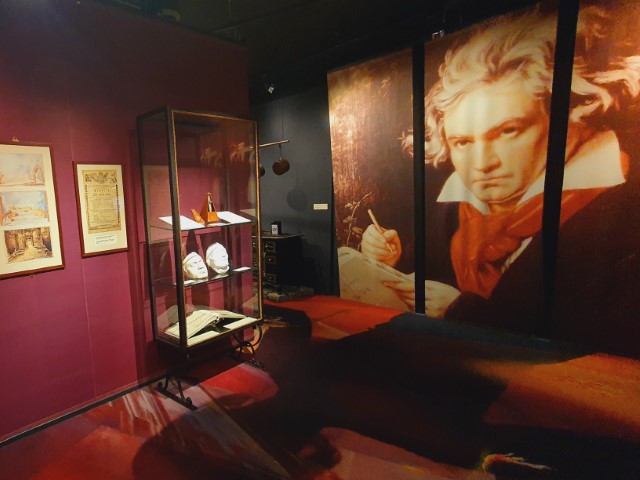
Next is one of the unique experiences of the House of Music: Origin. I found myself standing in a dark room with blue lights and markings on the floor.
As I walked around, I heard different sounds and noises. Some I could recognise, like waves or bells, but others were more mysterious.
The exhibition continues with more interactive displays on sound, the physics behind it, and how we hear.
The House of Music has so many things to do and see, it can easily keep you engaged for a couple of hours, especially if you want to try the interactive exhibits. A lot of thought was put into making this museum interesting and absorbing.
The next room has some bizarrely massive musical instruments you can play. The drum is so huge it almost reaches the ceiling.
Then you climb up to the composer rooms: Haydn, Mozart, Beethoven, Schubert, Johann Strauss II, and Mahler.
This section is fascinating. You’re welcomed by levitating holograms of famous composers.
Each of the major composers gets his own dedicated room with a beautifully designed exhibition about his biography and work:.
It was also interesting to learn more about the Second Viennese School – 20th-century composers who reinvented the rules of classical music, like Schoenberg and Berg.
Near the end of my visit I reached the Virtual Conductor game, where you can conduct an orchestra on the screen in front of you and the players react to your actions. I had to wait quite a bit of time for my turn to play, because it’s very popular with both kids and adults.
For anyone looking for classical music exhibitions in Vienna, the House of Music ticks all the boxes.
Johann Strauss Museum – New Dimensions

This museum is dedicated in its entirety to the life and legacy of the “Waltz King”.
If you know nothing or close to nothing about iconic composer Johann Strauss, this museum will teach you all you need to know.
It does that in the most creative ways, with clever use of multimedia, art, music, and storytelling. The innovative use of tech is what makes this museum unique.
I thoroughly enjoyed my visit. I’d say it’s suitable for both adults and teens who are into classical music.
You get an audio guide when you enter. It detects your location automatically, so no need to press any buttons. Just stand in front of a display and you’ll hear the narration and music right away.
The museum visit starts with setting the scene of the 19th century Viennese culture of music and entertainment, especially the waltz frenzy.
Then we were introduced to the somewhat disturbing family background of Strauss Junior. His father, Johann Strauss I, was a composer as well. While his mother, Anna Maria Strauss, encouraged his musicality, his father tried to sabotage it.
The exhibition continues with more biographical details, historical context, and a lot of music.
The Johann Strauss Museum is a very creative project. Smart use of touchscreens and projections bring the stories to life. In every room there was an element of surprise.
I loved the use of music together with animation, beautiful art, and multimedia throughout the exhibition.
I also liked seeing people dancing around the museum. Waltz is indeed very danceable.
The audio guide narration sounds like you’re reading a book. It was interesting, but at times I found it a bit too “dry” in relating historical facts.
However, the creative aesthetics of the exhibition make up for it. The visual experience here is strong.
Strauss’s role in Viennese culture was well established. The popularity of his famous piece, the Danube Waltz, made him an international star in Europe and even in the US.
It’s interesting to note the crucial role of women in his life: his mother, Anna Maria, who pushed him to realise his musical skills; Jetty, his wife, who encouraged his career; and Adele, his third wife, who was business minded and ran his company.
The final room has a beautiful immersive exhibition with projections on all walls. It was so good I stayed extra just to see it twice.
The exhibition area spans 900sqm across two floors and takes 75 minutes. It’s certainly one of the most impressive classical music exhibitions in Vienna.
I found the experience quite intense overall (in a good way). When I walked out onto the street it felt like waking up from a dream…
Mythos Mozart
I got curious when I read about Mythos Mozart online, though I didn’t fully understand what it was about at first. It promised a blend of tech, art, and music, so I had to check it out.
This project was a very refreshing experience.
It’s anything but a traditional exhibition. Rather, it’s a collection of multimedia artworks inspired by Mozart.
You walk along a fixed route with doors that open automatically just in time for you to visit the next room.
Every room there has a completely different immersive experience, one of them also interactive.

They’re all related to Mozart in some way, but don’t expect any linear storytelling about his biography or his work.
Mythos Mozart is more about artistic expression inspired by Mozart.
It’s hard to review Mythos Mozart without spoilers because it’s so unusual, so I’m keeping it a bit vague. I’ll just say that it’s super creative and surprising.
The exhibition is housed in the building where Mozart spent his final years, right in the centre of Vienna.
There are time slots for entry so it’s not crowded inside and you can walk around each room freely. The tour takes about an hour but I stayed longer in some of the rooms, so I spent about 90 minutes there.
Out of the classical music exhibitions in Vienna in this guide, this one is unique in that its main focus is artistic installations that are based on Mozart’s life and work.
Mozart House
Mozart House, or Mozarthaus, is literally Mozart’s house: one of the apartments he lived in, now a museum about his life.
It’s a traditional, old-school museum, but it does have an audio guide, which made a huge difference to the experience for me, so don’t forget to pick one up when you enter (it’s included in the ticket price).
Begin on the third floor, where the exhibition starts in chronological order from the time when Mozart moved to Vienna in 1781.
I learnt that Mozart was a freelance musician for several years before getting a permanent position in Vienna. Vienna was a major music hub at the time with plenty of concerts and musicians.
The exhibition looks at just about any aspect of his life that was documented in some way, from Viennese restaurants he used to frequent to his involvement with the Free Masons.
It makes extensive use of historical documents like letters and sheet music, many paintings and illustrations, and wonderful music samples.
The audio guide is rich in detail and it often took me more time to listen to the entire audio description than to see all the items in the room.
Visiting Mozart House really takes you through his life in Vienna and lets you see how his musical career evolved.
When you continue down to the second floor, you’ll learn more about his musical career and is major works, especially his operas. It was interesting to learn how he thrived as a composer thanks to his talent and social connections.
On the first floor we were reminded again that this was where he lived between 1784 and 1787.
A model of the apartment gives you a general idea of what it might have looked like when furnished and used by the whole family.
It’s speculative, but nice to imagine. The audio guide takes you through the rooms with interesting descriptions. There were no original furnishings or personal belongings, but in the study you can see a replica of a piano from that time period.
Mozart House is in a central location in Vienna, close to St Stephen’s Cathedral
It’s a popular tourist attraction, not just for classical music fans.
In the basement there’s a concert hall Sala Terrena for chamber music, used for performances by the Mozart Ensemble in period dress. I missed out on the concert when I was there, but the place should have excellent acoustics.
How to save money on classical music exhibitions in Vienna
Visiting all the classical music exhibitions in Vienna can be quite expensive. I found some ways to lower the cost.
Use the Vienna Pass to see all the classical music exhibitions in Vienna
I used the Vienna Pass to enter all the exhibitions in this guide.
It’s worth it if you plan to see a lot of attractions in Vienna in a few days. It covers most of the major attractions in the city.
I got the 6-day pass, used it every day, and it helped me save quite a bit of money.
It also saved me time, as I didn’t have to book each and every ticket individually, I just scanned the pass on my phone at each museum.
Use combo tickets for the top classical music exhibitions in Vienna
As an alternative to the Vienna Pass, you can buy discounted combo tickets to some of the museums and other attractions.
Offers change from time to time. These are the ones I found:
My tips on classical music exhibitions in Vienna
Opening times in Vienna
- Pay attention to opening hours. Many attractions in Vienna close around 6PM.
- The House of Music is an exception. I was surprised to find it was open till 10PM. The late opening times plus its central location give you flexibility in planning your itinerary.
Classical music exhibitions in central Vienna
- All the exhibitions above are in the city centre.
- Vienna is very easy to explore on foot and many attractions are within a short walking distance from each other.
- The Johann Strauss Museum is a little farther away but still fairly close. You can combine your visit to the Johann Strauss Museum with a visit to the Secession art museum across the street.
Classical music concerts in Vienna
- Apart from the concert hall at Mozart House that I’ve already mentioned, there are many classical music concerts in Vienna.
- I’ve also written a full guide to all sorts of classical music experiences in Vienna.
- Some concerts are designed especially for a tourist experience that just about anyone can enjoy, with period dress and very popular pieces.
- Some concerts also feature opera singers, and ballet dancers for a full Viennese experience, like the Strauss and Mozart Concert at Hofburg Palace.
- There’s plenty of choice, so you can find a concert any day of the week.
Browse more Vienna travel guides
Save this guide to classical music exhibitions in Vienna on Pinterest

8 Comments
All 4 classical music exhibitions sound interesting. I love museums, so would want to visit all 3 classic style museums. However the Mythos Mozart also sounds interesting. I’ve been to a lot of immersive experiences in Fabrique des Lumieres and they were fun.
I love the idea of exploring Vienna’s classical music history through exhibitions rather than only through concerts. Mozarthus would probably be my first stop.
I’ve not visited Vienna, however Vienna and classical music seem almost inseparable, so discovering the places connected with composers such as Mozart would be fascinating. I’d really enjoy exploring these exhibitions and locations one day.
Perfect post! This would be my #1 reason for visiting Vienna and it’s on my bucket list..saving these recs for the trip!
I’ve been to Vienna, but sadly, I didn’t have time to attend a classical music exhibition. I will for sure do so next time. These are excellent tips. I will make sure to use them. Mozart House would be so interesting to visit. I love Mozart’s music; it would be very interesting to see where he lived.
Vienna is one of my husband’s favourite cities, but I sadly have yet to visit. We have friends going in April – I will have to send them this post!
Fantastic information! I LOVE THIS! I plan to add much of this to my next trip.
Sounds thoroughly delightful!