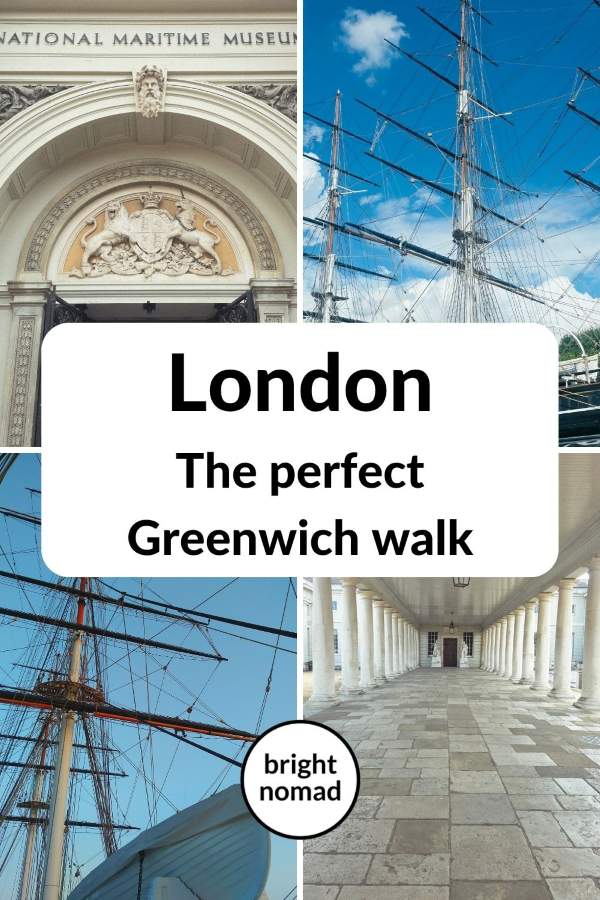
Take a self-guided walk in Greenwich to see all the highlights and a little more.
Greenwich is a pretty and calm part of London, located in the south-east but easy to reach from central London.
It has many historic places to see, all very visitor-friendly in my experience.
I’ve been there many times on multiple trips to London. It has a bit of everything: history, architecture, art, scenery, and science.
I created this Greenwich self-guided walk that takes you to the most famous museums in Greenwich, the lovely park, the market, and other places worth seeing in Greenwich.
Most of the places on this Greenwich tour are part of a UNESCO World Heritage Site (Maritime Greenwich).
Get an offline map of this Greenwich guide
This article is also featured on GPSmyCity. To download this article for offline reading or create a self-guided walking tour to visit the attractions highlighted in this article, go to Walking Tours and Articles in London.
Table of contents
How to get to Greenwich
Greenwich is a little bit outside central London, but it’s easy to reach.
Get to Greenwich by boat: Take an Uber Boat by Thames Clippers along the Thames for a scenic arrival to Greenwich Pier. Major central stops include: London Eye/Waterloo, Westminster, Embankment, and London Bridge City.
Get to Greenwich by train: Ride the Docklands Light Railway (DLR) to Cutty Sark station.
Greenwich self-guided walk route
I created a route that starts at the Cutty Sark DLR station, if you get to Greenwich by train, or at Greenwich Pier, if you get there by boat.
They’re both within a short walking distance from each other.
It’s a circular route, so at the end you can travel back by boat or by train.
Cutty Sark
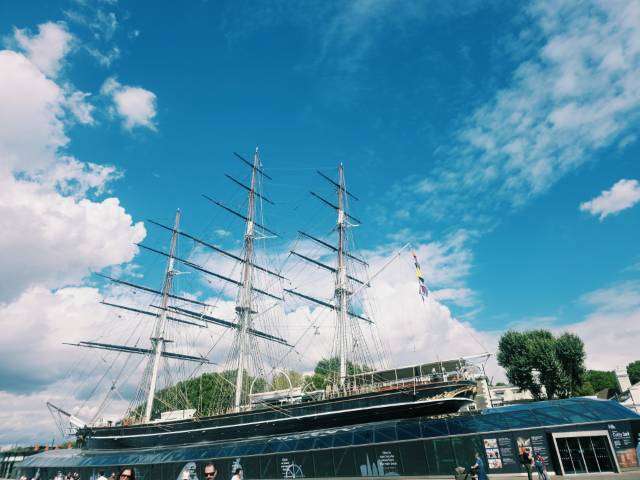
Our first stop is a large ship that’s really hard to miss when you exit the train station or the pier.
The Cutty Sark was considered one of the fastest clippers in the world in the 19th century.
The ship itself is striking enough from the outside, but the real magic is inside.
It’s dry-docked and the hull has been lifted above ground level, which means you can walk inside and below decks.
It’s interesting to walk up on the main deck too, learn about what life on board used to be like, and see the views across the river.
The Cutty Sark hosts exhibitions about the history of the ship and has a photogenic collection of figureheads.
The name Cutty Sark comes from a Robert Burns poem about a witch called Nannie, who wore a short chemise, a “cutty sark” in Scots.
This is a good introduction for the day, because you’ll come across many of the recurring themes in this Greenwich tour: maritime history, global trade, scientific development, and the complex story of the British Empire.
Tickets: Book online. Audio guide included. Included in the Royal Museums Greenwich Day Pass.
Time: About an hour.
Old Royal Naval College and the Painted Hall
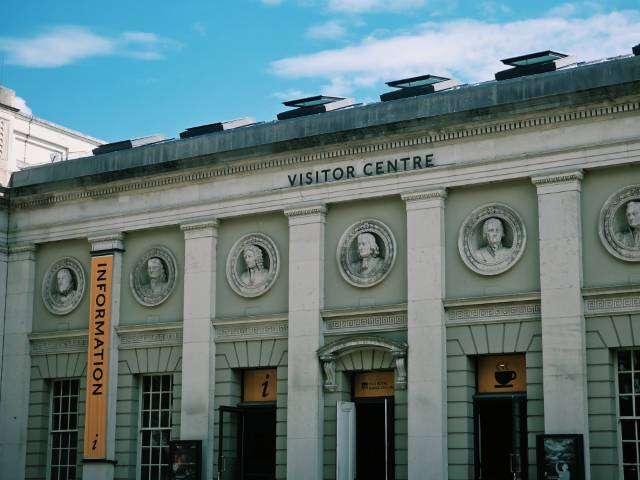
As you exit the Cutty Sark, you’ll see signs for another one of the famous places to visit in Greenwich: the Old Royal Naval College.
Follow the signs and enter via the Visitor Centre, where you’ll find both the Greenwich tourist information centre and the ticket desk for the Old Royal Naval College.
The Old Royal Naval College was built as a hospital for Royal Navy veterans.
It’s an architectural highlight in Greenwich, a baroque masterpiece designed by Christopher Wren.
When you enter, you’ll see an interesting collection of historical artefacts and interactive displays.
From there you can move around to see the other parts of the college and its grounds.
My personal favourites were:
- The Chapel of St. Peter and St. Paul, with a wonderful decorated ceiling and symbols of naval life.
- The Skittle Alley, a Victorian alley where you can play with wooden bowling balls dating back to 1864.
- The main attraction inside this complex: The Painted Hall, nicknamed “Britain’s Sistine Chapel”.
When I reached the Painted Hall l took out my camera and looked up.
The ceiling is covered with gorgeous Baroque paintings of queens, gods, kings, and mythological creatures.
The scale is impressive.
The paintings have political themes and symbolism, with references to British naval power and global trade, Protestant Britain vs. Catholic Europe.
It presents a celebratory vision of British power, including naval and imperial ambition. I think it gives you a good insight into how Britain imagined itself.
If you have the time and a good zoom lens on your camera, it’s worth looking at small details in the paintings.
When I visited, there was a temporary exhibition in the same space as well. It was abstract contemporary art that somehow merged very nicely with that imposing Baroque interior.
Tickets: Book online. Includes a guided tour.
Time: 1-1.5 hours.
Greenwich Market
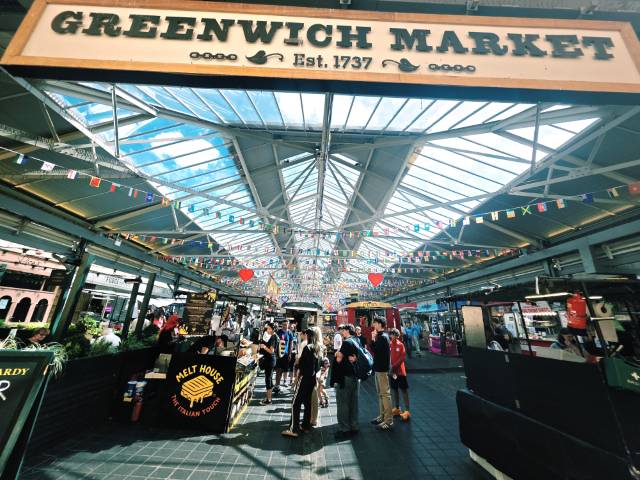
After you exit the Painted hall, walk a couple of minutes to reach Greenwich Market.
It’s a covered market that’s lively and colourful. It’s somehow both local and touristy. Great for foodies or vintage lovers.
Depending on the day you visit, you’ll find street food, independent art, handmade crafts, antiques, vinyl records, and an amazing fudge shop (The Fudge Patch).
It’s a good spot to stop for lunch or a coffee.
Entrance to the market is free.
Time: It’s a medium sized market. You can see it in under 20 minutes depending on how much you’d like to browse and shop. If you’re sitting down to eat, obviously allow more time.
Tip: If you want to shop at the market, ask at the stall about closing times and come back at the end of the tour, so you don’t have to carry your shopping with you all day.
National Maritime Museum
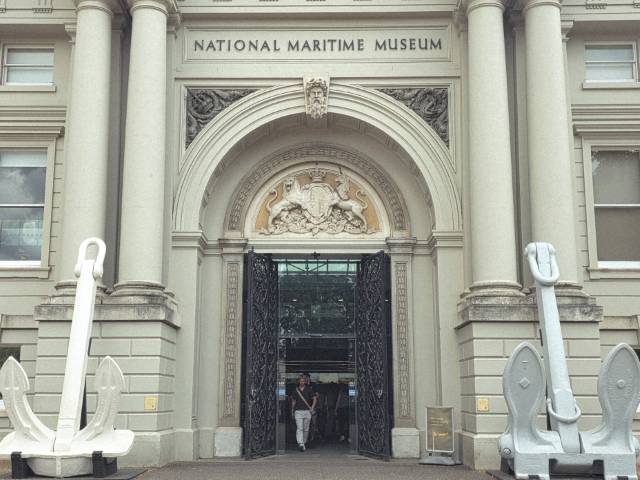
From the market, walk about 5 minutes to the world’s largest maritime museum.
When I entered the National Maritime Museum for the first time I didn’t realise quite how large it was.
You’ll see a map on the wall when you enter and you can always ask the staff for directions because it can be tricky to navigate.
The permanent galleries cover everything from Arctic exploration to the slave trade to the Apollo space programme.
I took the north wing lift to the second floor for a brilliant view of the museum from the bridge and then continued from there to see all three floors.
If you only visit a few sections, focus on Polar Worlds, the Tudor and Stuart Seafarers, and the Atlantic Worlds section.
Atlantic Worlds deals with the painful history of slave trade. It shows respect to the richness of pre-colonial cultures around Africa. There’s a reflection space at the end where you can sit down with your thoughts for a while.
I think that even visitors who are not especially interested in naval history often end up spending longer here than expected.
It’s just designed in a way that makes you want to explore…
Tickets: Free.
Time: 1-1.5 hours.
Queen’s House
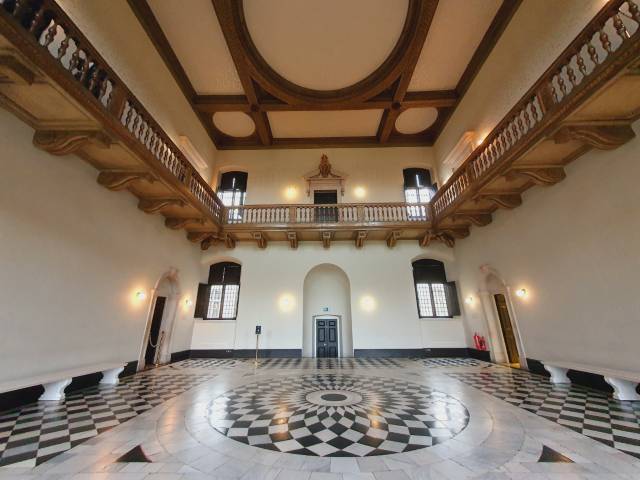
Right next to the National Maritime Museum, you’ll see Queen’s House, a great stop on this Greenwich walk for art lovers and architecture fans.
Enter through the small door and follow the visitor route inside.
There’s a short video introduction when you enter about the history of the house.
It’s a beautiful house to walk around. It holds a fine collection of paintings by artists like Gainsborough, Turner, Hogarth, and Reynolds.
The highlight of the art gallery is the famous Armada Portrait of Queen Elizabeth I.
It’s inside the Queen’s Presence Chamber, which also has a magnificent ceiling.
I spent quite a bit of time trying to take the perfect photo of the sweeping Tulip Staircase and its beautiful flower patterns (which are actually lillies).
Tickets: Free.
Time: About 30 minutes.
Royal Observatory and Prime Meridian
To reach our next stop, about 10 minutes away, you need to climb up a hill in Greenwich Park. You can easily see that hill from Queen’s House.
Once at the top, you get a panoramic view over the park, the Thames, Canary Wharf, the City and beyond.
Take photos and rest your feet (there are many benches around) before you enter the Royal Observatory.
This stop on this Greenwich tour is for science and history fans.
It was built in 1675 by Charles II to improve navigation and determine longitude at sea.
The red Time Ball on the roof drops every day at exactly 1 pm, and has been doing so since 1833 so that ships could set their chronometers.
The Prime Meridian that Greenwich is famous for is inside the Royal Observatory site.
A thin brass strip set into the courtyard of the Royal Observatory marks Longitude 0°, the line from which the world’s longitude system and standard time were historically referenced.
You can stand with one foot in the eastern hemisphere and one in the western. It’s a very popular spot with many visitors getting their picture taken.
Tickets: Book online. Included in the Royal Museums Greenwich Day Pass.
Time: About an hour.
The Rose Garden
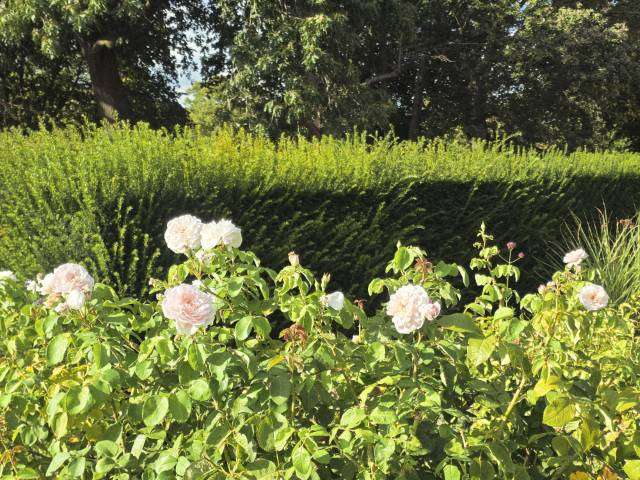
From the Royal Observatory start walking down through the park until you see a small door leading to a colourful garden.
The Rose Garden within Greenwich Park is one of the park’s quieter corners.
I visited in summer and the garden looked cheerful.
There are some benches around the garden if you’d like to rest your feet.
Time: About 10 minutes (or as long as you need to rest).
Ranger’s House – The Wernher Collection
From inside the Rose Garden you can already see the back of our next stop.
Our next stop is a bit of a hidden gem in Greenwich (though it was featured in Bridgerton), an elegant Georgian villa.
It’s well worth a visit if you like historic houses, old paintings, and stories of eccentric collectors.
Sir Julius Wernher spent much of his wealth buying art and decorative items, such as medieval jewellery, Renaissance bronzes, Flemish paintings, and Sèvres porcelain.
It’s a very diverse collection and quite extraordinary for one single person to have assembled.
When I entered the house, not knowing just what to expect, a volunteer approached me and offered to show me around. She gave me a tour of the entire collection.
Tickets: Book online. Check opening times (limited seasonal hours).
Included in the Go City London Pass and English Heritage membership.
Time: About an hour
The Fan Museum
Go back to the Rose Garden behind Ranger’s House and walk downhill through the park. When you see an exit to your left, leave the park and continue in the same direction downhill, until you reach one of London’s curious museums.
It’s the only museum in the world dedicated entirely to fans and the art of fan-making, housed in two beautifully restored Georgian townhouses.
The museum features a huge collection of fans of all kinds that founder Hélène Alexander began collecting in the 1970s.
It spans centuries, from delicate hand-painted Chinese silk to fans carrying eavesdropping tubes, fans designed by Salvador Dalí, and one extraordinary piece with a built-in ear trumpet.
Admittedly, I had no idea fans could be that interesting. I enjoyed my visit to this unusual museum especially because I got to learn a thing or two about the design of fans, as well as their historical social function.
Fans were used over the years not just as accessories but as a sophisticated way to communicate.
A closed fan held to the lips meant ‘I wish to speak to you.’ A fan twirled in the right hand meant ‘I love another.’ Courts across Europe could hold entire conversations just using fans.
Tickets: There’s a small admission fee. You can buy tickets on the door.
Time: About 45 minutes.
Tip: The gift shop sells some very beautiful handmade fans.
The end of this Greenwich self-guided walk
After visiting the Fan Museum, you’ll be very close to the market area where we started the tour.
There are plenty of places to eat and drink around there.
You can easily walk back to the Cutty Sark DLR Station or to Greenwich Pier in just under 10 minutes.
This is where our Greenwich self-guided walk route ends.
More quick tips on visiting Greenwich
Where to stay in Greenwich?
If you’d like to stay longer in Greenwich or even make it a base for your London trip, check availability at:
Places to visit near Greenwich historic centre

- Eltham Palace: an architectural gem well worth visiting, a short bus ride away from Greenwich. Here’s my full Eltham Palace review.
- Up at The O2 a 90-minute guided climb over the roof of the O2 arena, with panoramic views.
- Greenwich Foot Tunnel: a Victorian pedestrian tunnel under the Thames.
- Greenwich Peninsula Ecology Park: a hidden freshwater wetland between the Thames and the O2, with boardwalks, bird hides and wildlife.
- The Greenwich Peninsula’s art trail: free public art around the Peninsula by both famous and emerging artists.
Save this Greenwich self-guided walk on Pinterest