
What are the most essential Tokyo travel tips to know before your trip to Japan?
I’ve been to Tokyo twice now, and both trips were a success thanks to a lot of preparation and planning in advance.
The first time was overwhelming and confusing, but I learnt pretty quickly that Tokyo may be huge and crowded, but it’s well designed.
The second time I was better prepared and things went smoothly. I think preparation is key.
I made this guide to give you some of the most practical Tokyo travel tips. The things I learnt along the way and the kind of knowledge that helped me plan two trips to Japan successfully.
Table of contents
My top 9 Tokyo travel tips
Getting around Tokyo
Tokyo is enormous: plan by neighbourhood
Tokyo is home to around 14 million people in the city proper, and the greater metropolitan area pushes past 37 million. It’s huge.
Planning a visit to Tokyo is different to other, smaller cities. You want to plan by area, so you don’t end up spending a significant chunk of your trip on trains.
Before my trip I made sure to put everything I wanted to see on a map and saw which spots were in the same area, or within a short distance from each other.
I could sometimes spend a whole day in one part of the city (Ueno Park, for example, has enough things to do and see for an entire day).
On other days I’d visit 1-3 districts, but made sure they were close enough.
I relied heavily on my map and didn’t try to remember the city’s geography or the names of every street or neighbourhood. My brain was already over saturated.
Still, after a few days in Tokyo you’ll naturally develop a rough mental map of the main areas and how close they are to each other, for example, Shinjuku and Harajuku, or Asakusa and Ueno.
The train system is your best friend
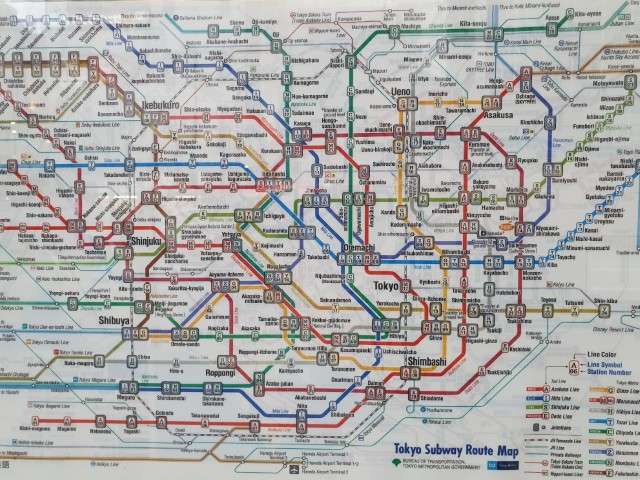
Tokyo’s train network is one of the most efficient in the world, but standing in front of a wall of coloured lines for the first time can feel overwhelming.
At first I got confused, got the wrong ticket, got lost, but eventually figured out how to navigate it. It’s actually much more logical than it looks.
Get an IC card
The first thing to do is get a Suica or Pasmo card.
These are rechargeable IC cards that work like a contactless wallet for almost every train, subway, bus, and even some taxis and convenience stores across the city.
You tap in, tap out, and the correct fare is deducted automatically.
Once I got my IC card I never had to queue for individual tickets or calculate fares.
You can pick one up at any major station and load it with cash on the spot.
You can even set up a digital Suica on your phone before you land (I haven’t tried that).
One of the reasons I got confused using public transport in Tokyo at first was the multiple transport companies and overlapping systems: the Tokyo Metro and the Toei Subway, plus the JR train lines, and even a few private lines on top of that.
It sounds like chaos, but in fact you rarely need to think about who operates what, because IC cards works across all systems.
For navigation, I used Google Maps on a daily basis and found it very efficient and reliable.
Just enter where you’re going, tap Directions, and select transit.
It will tell you exactly which line to take, which platform to stand on, and how many stops to count.
Transport outside of Tokyo
There are many places worth visiting in Japan and Tokyo is your gateway to the rest of the country with excellent connections.
The Shinkansen, the famous Japanese bullet train network, departs from Tokyo Station and Shinagawa and will get you to Kyoto in around two and a quarter hours, Osaka in two and a half, and Hiroshima in four.
If you’re planning to travel beyond Tokyo at all, look into the Japan Rail Pass before you leave home: it covers unlimited travel on most Shinkansen and JR lines for a set number of days, and crucially it can only be purchased outside Japan.
For day trips from Tokyo, Nikko, Kamakura, and Hakone are all under two hours away and easily reached without a pass.
If you plan to travel extensively in other regions of Japan, compare prices of regional rail passes to see where you can save.
Practical tips for Tokyo
The best time to visit Tokyo
The season when you visit Tokyo shapes what kind of city you experience.
Spring (March to May) is the beautiful cherry blossom season. It’s the most popular time to visit.
The parks and riverbanks look extraordinary. Shinjuku Gyoen, Ueno Park, the Meguro River all become magical.
If you’re planning a trip around this season, book accommodation months in advance and be prepared for the crowds.
Early summer (June) is the rainy season.
The city is less crowded, prices are lower, but it’s worth knowing that humidity may interfere with your plans.
If you do visit Tokyo in this season, pack accordingly and plan for more indoor activities, like visiting the wonderful museums in Tokyo or taking local Japanese workshops.
Summer (July and August) is hot, humid, occasionally interrupted by typhoons.
I’d avoid it if you don’t like heavy heat. You’ll need to plan ahead, always carry a bottle of water with you, and find shade stops.
If you don’t mind the heat, there are some great festivals in Tokyo in summer with traditional dance, street food, fireworks, parades, and even a water-splashing festival.
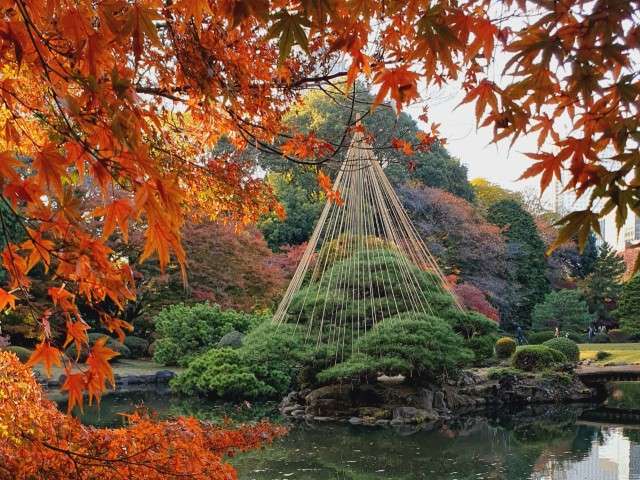
Autumn (September to November) is the other peak season for visiting Tokyo.
The main attraction of this season is the foliage in the city’s parks and temple gardens.
They all turn red, yellow, and orange. It’s a gorgeous experience.
The city is crowded in autumn, but not quite as crowded as in the cherry blossom season. Still, you want to book accommodation way in advance.
Winter (December to February) is cold in Tokyo.
Bring warm layers, a coat, scarves, and gloves, but use layers because trains and shops are heavily heated. Once you board a train or step into a shop, you’ll have to take off a layer or two.
Christmas in Tokyo is lively, with beautiful illuminations across the city.
January and February tend to be the most affordable months to visit.
Cash still matters more than you’d think
Quite a few places I’ve been to in recent years have become cashless, or at least encourage you to use card instead of cash.
I was a bit surprised to find that Tokyo wasn’t one of them. I made the wrong assumption that a country as technologically advanced as Japan must be entirely contactless and card-friendly.
In reality, I found many places in Tokyo that accepted cash and some that still run on cash only.
For example, small shrines that charge an entry fee, certain ramen counters, vending machines without a card reader.
My practical advice is to carry a reasonable amount of yen on you at all times. Just enough to cover a meal or an entry fee.
It’s also a good idea to have some cash on you in case your foreign card isn’t accepted for some reason.
Japanese etiquette tip: When you pay in cash, put your money on the small tray on the counter, rather than handing it directly to the cashier. It’s considered respectful in Japanese culture to handle money that way. I’ll talk about some other etiquette rules later in this post.
Convenience stores really are convenient
Japan’s conbini, the shorthand everyone uses for convenience stores, are everywhere in Tokyo. You will never be far from one.
The big three are 7-Eleven, FamilyMart, and Lawson.
Here are some of the things you can do or buy at a convenience store in Tokyo:
- Food and drink to have on the go, and sometimes to eat in.
- Many other useful products, from medicine to clothing.
- They often have an ATM (particularly 7-Eleven’s).
- You can print documents at the in-store machines if you need to, like boarding passes, maps, or tickets.
- If you’ve booked a ticket for a show, a theme park, or the Ghibli Museum and need to collect it physically, the conbini machine is often where you do it with an English interface.
- You can top up your Suica card and buy Shinkansen tickets and highway bus tickets.
- You can send a package across the city or to the airport using the takkyubin luggage forwarding service.
What to prepare before you go to Tokyo
Pocket Wi-Fi, SIM card, or eSIM?
Deciding how to stay connected before I arrived in Tokyo was a bit complicated.
There were more providers and plans for tourists than I’d ever seen in any other country in Asia or Europe. Way to much choice.
Generally, your options are: eSIM, SIM card, or Pocket Wi-Fi. The prices and data plans change from time to time, so you can browse current offers here.
eSIM
Using an eSIM in Japan is now the easiest option for most visitors.
Instead of a physical card, you buy it online, receive a QR code by email, scan it, and your phone is ready.
You can do all of this before you board the flight, which means you land in Tokyo already connected.
Just make sure your phone supports eSIM (it should do unless it’s an old phone). If it doesn’t, look at the other options below.
Check my digital nomad eSIM guide for more tips.
SIM card
I ended up pre-ordering a local sim card for my dual sim phone and it worked out great.
It was the most convenient option for me as I travel solo and the plan I picked gave plenty of data for the 6 weeks I spent in Japan, so I never had to worry about running out.
You can buy a sim card when you arrive in Japan at electronics shops like Yodobashi Camera or BIC Camera that carry a large selection.
I found it easier to pre-order the card. You can pick up your pre-ordered sim at the airport if you land in Tokyo or in one of the major airports in Japan.
I landed in a smaller airport, so I arranged for the sim card to be sent directly to my accommodation.
Pocket Wi-Fi
This solution is still popular in Japan. It’s a small device that creates its own mobile hotspot and can provide Wi-Fi to multiple devices at the same time.
If you’re travelling as a family or in a group, everyone can share the same device.
You pick it up at the airport on arrival (there are rental desks in the arrivals hall at Narita and Haneda) and return it before you leave.
The connection is fast and reliable across the city.
I personally didn’t want an extra device to carry with me all day, which I’d also have to keep charged.
But I travelled solo in Japan and I suppose for a group of people travelling together, splitting the cost, pocket WiFi makes more sense.
Apps for your Tokyo trip
I recommend downloading useful apps for your trip at home before you go.
Here are the most useful apps for Tokyo:
Google Translate was an essential app on both my trips to Japan.
I used the camera mode every day to read signs, menus, and ingredients of food packaging (the latter is super helpful if you’re travelling as a vegan in Tokyo).
It’s very easy to use. Point your phone at text in Japanese and it overlays a translation in real time.
You can also take a photo of anything, upload it to the app and see the translation.
Before you leave for Tokyo, make sure to download the offline Japanese dictionary.
This means it works without a data connection.
I met other tourists who also recommended DeepL as a translator app.
Google Maps was the app I used for navigation everywhere in Japan.
It works well for Tokyo’s public transport and also for walking directions.
It will tell you which line, which platform, which exit, and how long the walk is from the station.
As a backup, use Japan Travel by NAVITIME.
Klook was a useful resource on my trip to Asia, not just in Japan.
I booked most tours, day trips, entry tickets, workshops, and even train tickets on this app.
It also has sim cards, accommodation, restaurants, and other activities.
It’s a very comprehensive app which was helpful at the planning stage as well, because I discovered things to do just by browsing it.
The main advantage is the language. It makes everything accessible in English without relying on machine translation. It saved me quite a bit of effort and confusion.
Agoda is a good app for booking accommodation, especially in Asia. You can sometimes find regional promotions on hotels, guesthouses, apartments, and ryokans.
Suica is useful for trains, metro, buses, convenience stores, vending machines, lockers, and more.
Polite behaviour in Tokyo
Japanese etiquette rules
Japan has a reputation for having a lot of social rules, but most of them apply to locals rather than visitors.
It’s a relief to find out that nobody expected me as a foreign tourist to have internalised years of cultural nuance.
Still, you want to be aware of local etiquette in Japan and respect the basic rules so you don’t come across as rude.
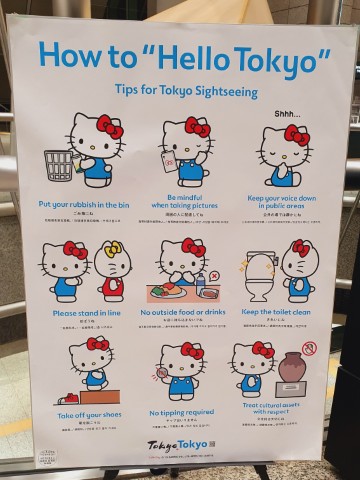
I’ve already mentioned putting money on a tray rather than handing it directly when you pay. That’s a rule you’ll be following daily.
Another basic rule that doesn’t seem intuitive to a Westerner regards eating while walking on the street.
It’s seen as inconsiderate, so you’re expected to step aside, find a bench and sit down to eat.
When you take trains in Tokyo you’ll notice there’s no eating or drinking there either. On long-distance trains in Japan it’s OK to eat during the ride.
Trains in Tokyo are also fairly quiet. People don’t talk on the phone and even avoid talking to each other. If they do, it’s in a very low voice.
The priority seating near the doors is taken seriously; give it up without being asked if someone needs it.
In Japan it’s common to take your shoes off when you enter people’s houses, traditional ryokan accommodation, some temples, certain restaurants with tatami seating.
Finally, rubbish bins are genuinely hard to find in Tokyo, yet the streets remain clean. Carry a small bag for your rubbish until you find a bin.
I’d usually go to a conbini to use their bin, or just take my rubbish back to my accommodation.
Tipping in Tokyo
If you’re from a country where it’s normal to tip at restaurants or taxis, you might be surprised to find that in Tokyo tipping is considered rude.
Tipping is not part of Japanese service culture. If you leave money on the table or press a note into someone’s hand, it will cause confusion or discomfort.
It can be interpreted as suggesting that the person needs charity, or that you see the transaction as something other than what it is, namely a professional exchange where excellent service is simply the standard.
One exception is when you take free walking tours in Tokyo because these are based on tips as a business model. You pay the guide as much as you like at the end of the tour.
In other cases, express your gratitude simply by saying thank you.
Save these Tokyo travel tips on Pinterest
7 Comments
Such a helpful collection of tips for a first trip to Tokyo! I especially like the practical advice about navigating public transportation, using an IC card, and choosing where to stay. Planning around neighborhoods rather than constantly crossing such a huge city makes so much sense.
As someone who would love to go to Tokyo someday, this post was extremely helpful! I love that you added in cultural “rules” as well.
Friends of mine have just been and loved it! That is such useful information you’ve provided about the Suica or Pasmo card, and the Japan Rail Pass. It’s on the bucket list!
We often don’t think of having cash on hand when traveling, so very helpful that we’re prepared before visiting Japan.
Fantastic tips for first timers to Tokyo! Having an app that can translate photos is so useful, I’ve used that on almost every vacation for signs and menus.
I’ve been to Tokyo and though is not one of my favorite cities in the world I may see myself going back one day so thanks for the tips in the article.
Thanks for sharing, these are such good tips, I will think about using them if I ever go to Tokyo on a holiday 🙂