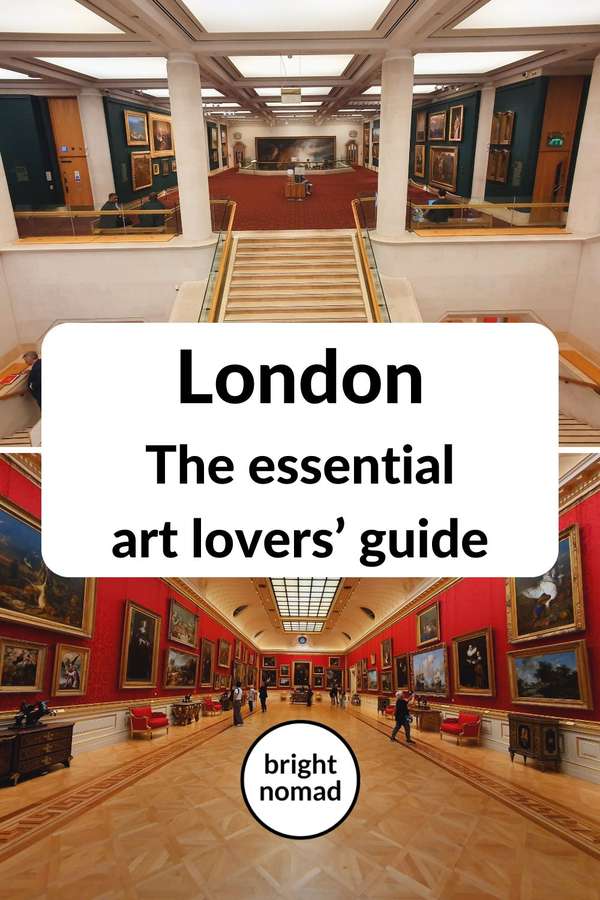
Use my London art guide to discover where to see art exhibitions in London and find your way around the London art scene.
London is one of the world’s biggest art capitals.
There are three things I love about it:
- I can see art at major, world-famous museums, as well as at a pretty amazing range of smaller galleries.
- Great public art, street art, and unique or alternative art spaces.
- Any art style and period are represented.
Art is everywhere you look in London. When you’re spoilt for choice as an art lover, you can easily get overwhelmed. I know I was on my first trips to London.
Now, having visited London many times, I made this this quick London art guide with a curated selection to help you focus and discover the best exhibitions.
Get an offline map of this London art guide
This article is also featured on GPSmyCity. To download this article for offline reading or create a self-guided walking tour to visit the attractions highlighted in this article, go to Walking Tours and Articles in London.
Table of contents
A quick London art guide: museums, galleries, experiences
This art lover’s guide to London highlights the most essential places to see art in London and why you should visit them.
The famous museums
Let’s start this London art guide with the most famous museums in London.
They’re all free to enter (except special exhibitions).
Collectively they hold some of the most significant art and artefacts ever made.
Tate Modern
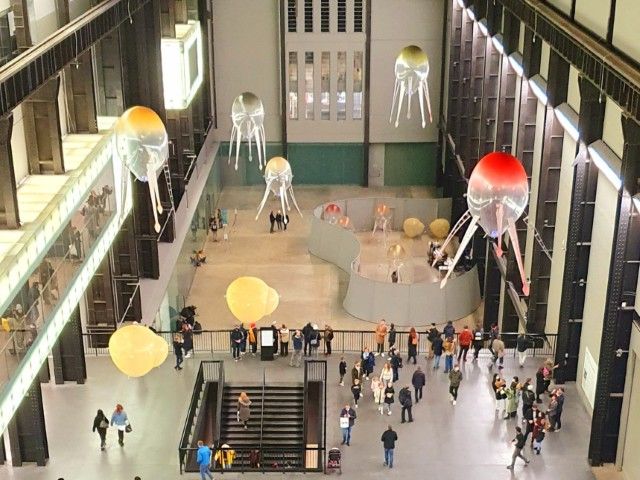
The world-famous home of international modern and contemporary art. Housed in a converted power station, the collection spans painting, sculpture, installation and film from 1900 to the present day.
Expect to see works by Picasso, Rothko, Louise Bourgeois, alongside contemporary artists.
The vast Turbine Hall hosts one major free commission each year, and it’s usually the most talked-about artwork in London.
Bonus tip: Ride the lift to the 10th floor and enter the Blavatnik Building viewing level. The view across the Thames to St Paul’s is just wonderful.
Tate Britain

Tate Britain focuses on British art and features the world’s largest collection of British art from 1500 to the present day, from Tudor portraits to the Turner Prize.
It’s home to the definitive collection of J.M.W. Turner’s work, alongside other artists, some better known than others.
Bonus tip: The Tate Britain Duveen Galleries are a stunning neoclassical space designed especially for sculpture.
The British Museum
Technically not an art museum, but it does have an immense collection that includes art and artefacts of all kinds.
Around 8 million objects spanning two million years of human history.
Some of the famous items in the collection include: Parthenon Sculptures, Egyptian mummies, and the Rosetta Stone, the Lewis Chessmen, and Sutton Hoo.
The museum is huge and you can’t see everything in one day, but you can take tour to see the highlights. I’ve written an overview of the best British Museum tours.
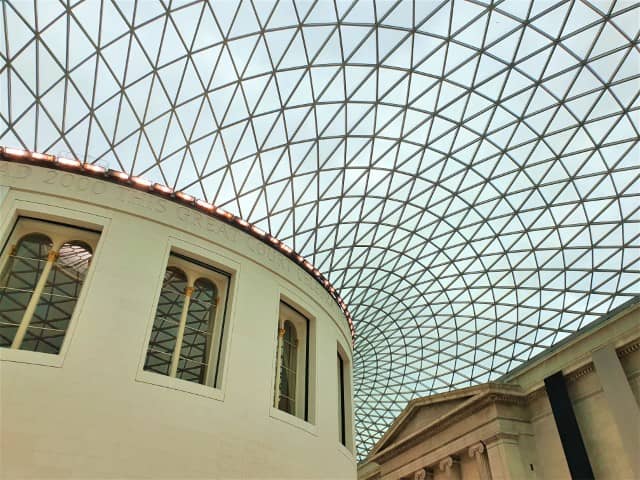
Bonus tip: The Great Court, Norman Foster’s stunning glass-roofed atrium, is an incredibly beautiful piece of architecture worth experiencing, especially if you enter the museum in daylight and leave after dark.
The National Gallery

A fantastic collection of Western European paintings and a very popular museum in London.
Expect to see works by Van Eyck, Titian, Caravaggio, Velázquez, Rembrandt, Turner, Van Gogh.
Van Gogh’s Sunflowers is a powerful painting to see in person as you’d hope.
The breadth and quality is staggering.
Bonus tip: You want to book a free ticket with a time slot to avoid waiting in line.
National Portrait Gallery
The National Portrait Gallery tells British history through faces.
Monarchs, scientists, writers, musicians, politicians and subversives, from the Tudor period to the present. Some faces you’ll probably recognise.
It reopened in 2023 after a major renovation.
V&A – Victoria & Albert Museum
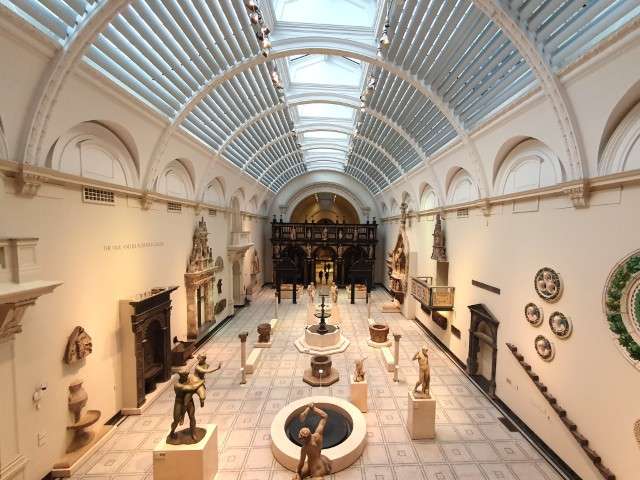
The V&A covers art, design, fashion, ceramics, jewellery, furniture and textiles across human history and across the globe.
It’s an enormous museum that you’ll have to visit quite a few times just to begin to appreciate how remarkable it is.
Some of my favourite highlights:
- The Cast Courts with their plaster reproductions of Trajan’s Column and Michelangelo’s David
- The fashion collection
- The photography gallery
Bonus tip: On the last Friday of every month, visit the V&A for Friday Late. The museum is open until 10 pm with performances, DJs, films, installations, and a very energetic atmosphere.
Major galleries in London
Some of the the major galleries in London are a little bit outside the centre, but not very far, and well worth travelling to.
These are also generally free to enter (except special exhibitions in some cases).
I selected the main ones to be included in this essential London art guide.
Serpentine Galleries
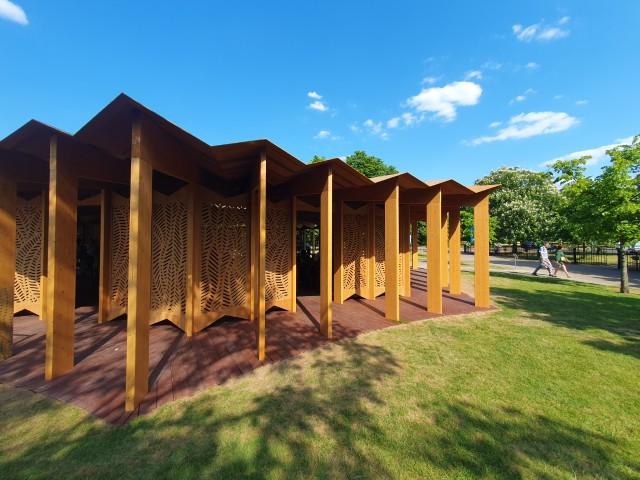
Two galleries in the middle of Hyde Park, one in a converted 1930s tea pavilion, one in a former gunpowder store.
They exhibit some of the most adventurous contemporary art in London.
They’re fairly close to each other and you can visit both on one day and take a walk through the park.
Bonus tip: The summer Pavilion, in which a leading architect builds a temporary structure in the park each year, runs from June to September/October and is free to enter.
White Cube
White Cube played a key role in promoting Damien Hirst and Tracey Emin and has been central to British contemporary art for three decades.
The Bermondsey space is its largest. It’s a vast, warehouse-scale building on one of south London’s coolest streets.
The programming is strong and consistently draws serious international artists.
Bonus tip: There’s a second White Cube in central London called White Cube Mason’s Yard that’s also worth visiting
Saatchi Gallery
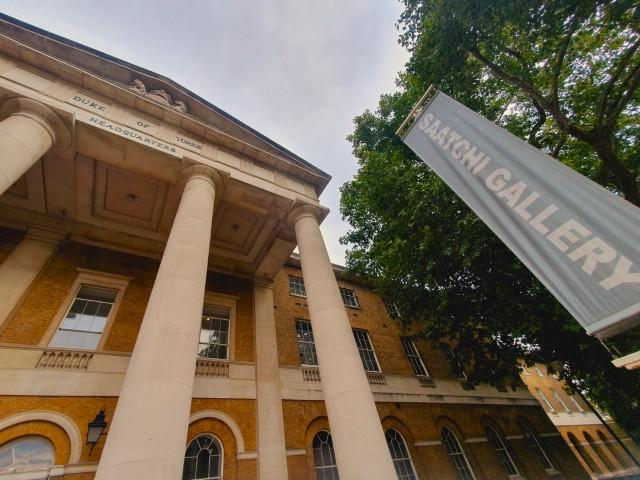
The Saatchi Gallery has played a defining role in British contemporary art since the 1980s.
Today it maintains a wide-ranging programme of emerging and mid-career artists from around the world, with a particular strength in photography and new media.
It’s located in Chelsea in the large Duke of York’s Headquarters building
Bonus tip: There are many smaller art galleries scattered around Chelsea that you can visit on the same day.
Unique art experiences in London
Moco Museum
Moco is a private museum showing modern art, street art, pop art, and contemporary work.
Expect familiar names such as Banksy, Keith Haring, Basquiat, and Warhol.
It’s deliberately accessible and enjoyable.
I think it’s the kind of place you can take people who say they don’t like museums. It will give them a good entry point if the more traditional museums feel intimidating.
Frameless
Frameless is an immersive digital art experience in which famous paintings, from Canaletto to Klimt to Monet, are projected floor-to-ceiling across four vast rooms with spatial audio.
It’s not trying to be a traditional gallery and it caters for everyone, including kids.
V&A East Storehouse
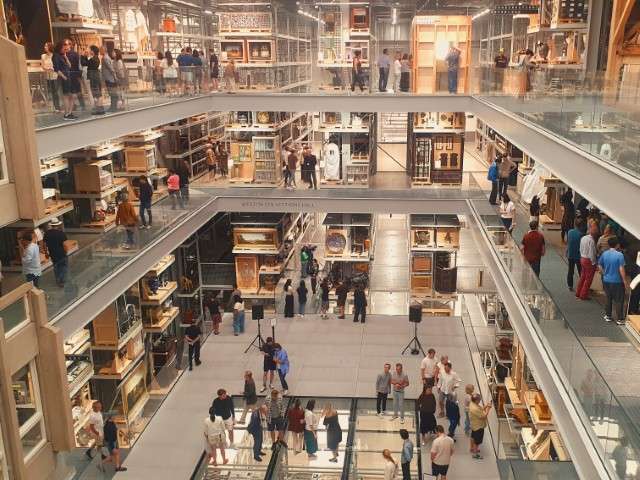
Part of the Victoria & Albert massive collection of objects was moved into a stunning new building in Stratford (East London).
It’s now accessible to the public in a magnificent, curated display.
This is a different kind of museum experience: objects are displayed in their storage context, you can see how the collection is organised and conserved.
The storehouse itself is vast and I enjoyed the architecture as much as the collection.
Bonus tip: The ‘Order an Object’ experience lets you request to see specific items from the reserve collection up close in a private viewing room.
Outernet
Outernet is an unusual experience: floor-to-ceiling digital art right outside Tottenham Court Road station in central London.
It’s a series of massive LED screens surrounding an open plaza.
It’s entirely free, runs throughout the day and evening, and I’ve often found it not too crowded.
Contemporary art galleries in central London
Central London is a paradise of contemporary art galleries.
They exhibit some of the most important contemporary artists working today.
All the galleries are within walking distance from each other, so I often spend half a day just walking around and browsing.
In this London art guide, I choose to feature my selection of the main galleries, but of course there are many more you can discover while walking around Mayfair, Fitzrovia, and St James’s.
Gagosian
One of the biggest names in the international gallery world, and its London space on Grosvenor Hill is one of its best.
Expect impressive works by major names.
Thaddaeus Ropac
Housed in a magnificent former Georgian townhouse on Dover Street, Ropac is one of the most architecturally impressive gallery spaces in London.
The scale of the rooms allows for ambitious large-format work.
Bonus tip: Don’t miss the second floor.
Halcyon Gallery
Halcyon occupies a beautifully renovated space on New Bond Street and regularly shows work by blue-chip names alongside more accessible contemporary artists.
It leans more towards commercial work and less “cutting-edge contemporary” than others on this list.
Hauser & Wirth
One of the most influential galleries in the world.
It has exhibited some major artists such as Louise Bourgeois, Cindy Sherman, Gerhard Richter, alongside contemporary artists.
Bonus tip: The gallery occupies two separate buildings a short walk apart (the North Gallery and the South Gallery), so make sure you see both, as the shows often work across them.
David Zwirner Gallery London
The London outpost of one of New York’s great galleries, spread across an elegant townhouse on Grafton Street.
It’s a premier contemporary art gallery that represents and has exhibited some internationally renowned artists, such as Yayoi Kusama, Gerhard Richter, and Wolfgang Tillmans.
Pace Gallery
Spacious and well-lit gallery rooms, ideal for the kind of immersive painting and sculpture Pace tends to show. Recent highlights have included Yoshitomo Nara and Nigel Cooke. A reliable stop on any Mayfair gallery crawl.
Sprüth Magers
Sprüth Magers has a reputation for rigorous, conceptually serious programming.
The gallery represents artists like Cindy Sherman and Donald Judd, and often mixes established figures with younger artists exploring related ideas.
The building itself is a draw: a wonderful piece of architecture that gives the space a distinctive character.
Are there any more art spaces that belong in this essential London art guide? Let me know in the comments below.
Browse more UK art guides
- The best London museum tours
- Find contemporary art in London
- Art, design, and indie shops in York
- Art guide to King’s Cross
- Birmingham guide for art lovers
- Galleries in Newcastle upon Tyne
- The best photography galleries in London
Browse more London culture guides
- See Shakespeare plays in London
- How to see the Wallace Collection
- Agatha Christie London guide
- How to visit the Harry Potter studios
- What are the best musicals in London?
- Visiting Eltham Palace
Pin this essential London art guide on Pinterest