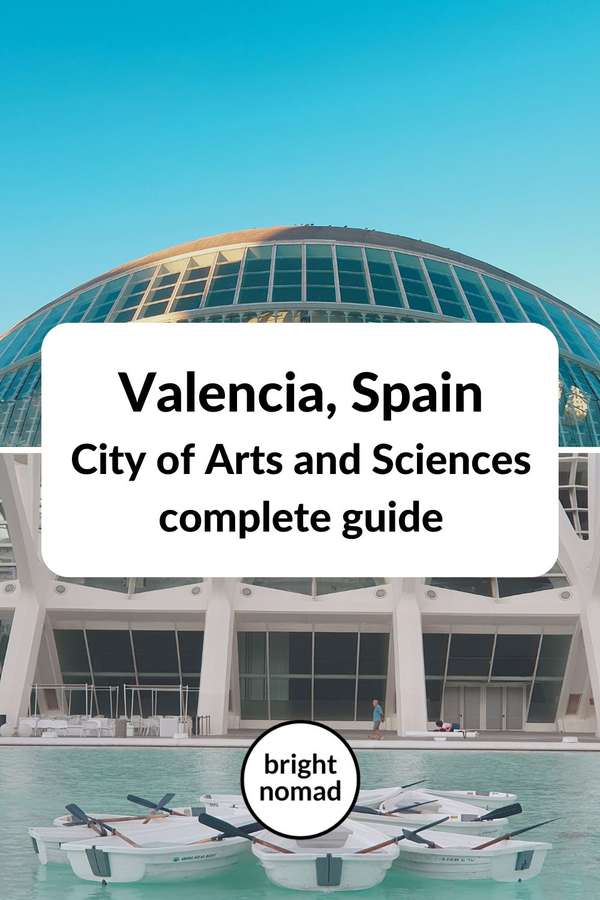
In this post I share my experience visiting the City of Arts and Sciences in Valencia, Spain, plus all the information and tips you need to plan your visit.
I spent a couple of months in Valencia and couldn’t get enough of the stunning City of Arts and Sciences.
It’s one of the most impressive architectural landmarks I’ve seen anywhere in Europe.
This unusual complex of futuristic buildings is definitely worth a visit on your trip to Valencia.
It has several different buildings and many attractions and activities you can engage with.
In this guide, I’ll explain exactly what to see and do at the City of Arts and Sciences, which attractions are worth visiting, whether you need tickets and what the different ticket options are, how much time to spend there and how to get there.
Table of contents
What to see at the City of Arts and Sciences?
What can you see at the City of Arts and Sciences? There are several different attractions in the complex, including the Hemisferic cinema and planetarium, the beautiful Umbracle garden, the Science Museum, and more.
Walking around the complex gives you plenty of opportunities to appreciate the buildings, their unusual shapes and the way they interact with the water and surrounding landscape.
Here are my impressions after visiting the various buildings and attractions.
Hemisferic

The Hemisfèric building is impressive from outside, but the main reason to go in is to watch a screening.
It’s not a conventional cinema visit, but an IMAX cinema, where you can see a 3D movie inside a massive dome, with the screen surrounding much of your field of vision.
I really enjoyed the movie and the optical illusion was just perfect. At some point, I really felt like my seat was floating in the air.
The narration for the 3D movies is in Spanish, but you can get a headset with dubbing in English and other languages.
The movies last about 45 minutes each and there are several screenings of different movies throughout the day. Pick a movie and a time slot when you book your tickets.
The programme includes films on subjects such as nature, science and astronomy. The subject of the film will make a big difference to how much you enjoy it.
The Hemisferic is shaped like a massive eye when you look at the sphere from the outside. Hence its other name – “the eye of knowledge”.
I got a chance to see it illuminated at night with a reflection on the water that mirrors the building, creating the full shape of this stunning eye. You can take some fantastic photos of that reflection.
Umbracle

L’Umbracle is a landscaped walkway running beneath a series of large white arches.
Under the beautiful arches, you’ll find a peaceful, landscaped sculpture garden with palm trees and many different types of Mediterranean plants typical to Valencia.
Take a walk under the palm trees and discover the contemporary sculptures positioned around the Umbracle.
I loved the playfulness of the arches and the trees. The plants, sculptures, and beautiful architecture all made the experience memorable.
It also offers a slightly different perspective of the surrounding buildings, with views across parts of the complex from above, so you can see see how the different structures relate to one another.
You don’t need to set aside much time for L’Umbracle. Around 20 to 30 minutes should be enough to walk along it, look at the sculptures and take some great photos.
It’s also a nice place to pause between visits to the indoor attractions.
At night, part of the space operates as an open-air nightclub, known as Umbracle Terraza, with its own programme and admission. This is different from the garden walkway you can explore during the day.
Science Museum

The Prince Felipe Science Museum is a large museum dedicated to all aspects of science, from biology to astronomy, covering human body, genetics, space and scientific discoveries.
This building is fascinating to look at from the outside before you go in. It’s by the water and the reflections create many cool photo opportunities.
It reminded me of a skeleton of some sort, and I later found out that it was designed to look like a skeleton of a whale.
You can enter the ground floor for free to see the skeleton from a different angle. There were also some free shows on the ground floor when I visited.
To see the rest of the exhibitions, buy tickets and plan to spend about 2-3 hours at the museum.
Inside you can explore three floors of hands-on exhibits and live science shows. The idea is to make science accessible through experiments, displays and hands-on activities.
The exhibitions and displays vary quite a bit. Some are more engaging than others, but overall the museum is worth visiting.
One of the more impressive displays is the Chromosome Forest, where you walk among 23 pairs of giant sculptures representing the human genome.
There are all sorts of interactive games, a space simulator, an Electricity Theatreand, a play zone for the kids, and various changing exhibitions.
A practical detail: you can leave the museum and come back in on the same day, as long as you keep your ticket. There are luggage lockers on the first floor.
Agora

L’Àgora is the large blue structure near the end of the complex.
Its unusual shape and metallic-looking exterior make it one of the most distinctive buildings in the City of Arts and Sciences.
It’s a multipurpose space with a museum, an auditorium, classrooms, a bookshop, and various other cultural spaces, pop-ups, and events.
Walking into the building you’ll want to look up straight away. There’s a lot to see. I felt it was designed to impress; I’d never seen anything quite like it.
The exhibition spaces are arranged around a central area, with unusual architectural features that make the most of the building’s height and scale.
The building houses CaixaForum València, a cultural centre with temporary exhibitions. I enjoyed my visit to the exhibition. Check what’s on to see if the current exhibition interest you.
Palace of Arts

The Queen Sofía Palace of the Arts has a concert hall, opera house, and theatres all in one centre.
It’s a major cultural venue in Valencia, where you can find a range of performances, including classical music, opera, ballet and Flamenco.
Even if you don’t plan to attend a performance, it’s worth walking around the exterior to see the building from different viewpoints.
The shape of the building is intriguing and futuristic, with sweeping curves and beautiful glass foyers. It’s the largest buildings in the complex.
If you’d like to see inside, the Palau de les Arts offers guided tours with a live guide or with an audio guide.
Depending on the tour and the programme at the time, you may also get to see some of the performance areas and backstage spaces.
Oceanografic
One of Europe’s largest aquariums. I personally do not go to attractions involving animals. I encourage people to think for themselves, of course, so simply Googling “Is the Oceanografic ethical” will turn up some useful results, and you can decide if it’s up to your standards on animal cruelty.
Tickets to the City of Arts and Sciences

Tickets are only necessary if you want to go inside some of the individual attractions.
Science Museum
A visit to the Science museum can easily take a few hours, so check what’s on and see if the exhibitions interest you before booking.
The exhibitions cover a range of subjects, with plenty of interactive, hands-on displays.
Hemisfèric
The Hemisfèric is the large eye-shaped building with a reflecting pool surrounding it.
Inside, it houses an IMAX cinema and planetarium, where you can watch different films and projections on a huge concave screen.
Tickets are for a specific screening, about 45 minutes each, so check the programme and choose a film and a time slot when you make your booking.
Combined tickets
A combined ticket can work out cheaper than purchasing separate tickets to each attraction.
It’s also great if you’re going to plan a whole day at the City of Arts and Sciences.
TheOceanogràfic, Hemisfèric and Science Museum Combo Ticket is valid for one day.
Make sure to pick a time slot for the Hemisfèric Cinema when you book the combo ticket and plan your schedule for the day around it.
The Palace of Arts
If you’d like to see a performance at the Palace of Arts, check the schedule on the official site, where you can book tickets.
What you don’t need to book for
You don’t need a ticket to visit the City of Arts and Sciences itself.
You can walk around the complex, appreciate the architecture and see the outdoor spaces for free.
The Umbracle is free to visit.
The Agora building is free to enter, but for CaixaForum (the museum inside the Agora building), you’ll need a ticket. I got mine on the door without having to queue and there was no need to book ahead.
Guided tours of the City of Arts and Sciences
Take a walking tour with a local guide to learn about the City of Arts and Sciences in depth.
Alternatively, you can take tours on wheels: a private bike tour, or a private segway tour with a guide. That’s a fun way to discover the area, as well as the lovely Turia Park. On a private tour, you can personalise the route to fit your interests.
How to get to the City of Arts and Sciences

Though it’s one of the top attractions in Valencia, the City of Arts and Sciences isn’t quite in the city centre. However, Valencia isn’t a huge city, so getting there is quick and easy.
Public transport: The metro network in Valencia is excellent. I enjoyed using it. The nearest metro stop to the City of Arts and Sciences is called Ciutat Arts i Ciències – Justícia.
If you take line 10 from the Alacant metro station in the city centre and get off at Justícia station, you’ll reach the City of Arts and Sciences in less than 15 minutes.
There are quite a few bus lines that can take you to the City of Arts and Sciences. It’s best to check on the EMT Valencia app or on Google Maps to see up-to-date schedules and routes.
If you use public transport a lot in Valencia, I recommend you get a SUMA10 card for 10 rides at a discounted rate.
On foot: As the City of Arts and Sciences is right at the end of Turia Park, a long park running through the city, you can reach it on foot by walking in this wonderful park.
I suggest you start at Alameda metro station. From there it should take about 25 minutes to reach the City of Arts and Sciences on foot.
What’s the best time to visit the City of Arts and Sciences?
The best time to visit the City of Arts and Sciences depends on whether you want to see the buildings from inside or mainly enjoy the architecture from outside.
If you’re visiting the Science Museum, CaixaForum or the Hemisfèric, check the opening hours first. The Hemisfèric requires you to book a particular screening with a time slot.
Once you know the schedule for the indoor attractions, you can plan your day around those opening times and leave some time to walk around the outdoor areas.
The buildings look quite different throughout the day, especially the reflecting pools.
Early morning for a quieter visit
Early morning is a good time to explore the complex without as many visitors around. The light is softer, the outdoor walkways are quieter and the pools create clear reflections of the buildings.
If you’re visiting Valencia in summer, it’s also a more comfortable time to walk around before it gets too hot.
Late afternoon for the changing light
Late afternoon is another good time to visit, especially if you want to see the buildings in a beautiful warm light.
As the sun starts to set, the white structures take on warmer tones and you can notice different details in their shapes.
This is a good time to walk around at a leisurely pace, stop at different viewpoints and take some impressive photos.
Evening for the illuminated buildings
If you have time, try to see the City of Arts and Sciences after dark as well. The buildings are illuminated, and their reflections in the pools create a different view of the complex.
You could visit one of the ticketed attractions earlier in the day and return later for a walk around the illuminated buildings.
Can you visit the City of Arts and Sciences for free?
Yes, parts of it. You can visit the outdoor areas of the City of Arts and Sciences without buying a ticket. They’re open to the public, so you can walk around the complex, enjoy the architecture and take photos.
The first time I visited the City of Arts, that’s just what I did, because I didn’t know about the activities inside the building.
L’Umbracle is free to visit and so is the ground floor of the Science Museum and the public spaces of the Agora.
You only need to buy tickets if you want to go inside the individual venues.
The architect behind the City of Arts and Sciences: Calatrava
If you enjoyed the architecture at the City of Arts and Sciences, you might want to know more about the architect, Santiago Calatrava.
A renowned Spanish architect, engineer, and sculptor, Calatrava has a remarkable artistic and futuristic style that’s easy to recognise.
Some of the famous buildings by Calatrava include:
- Milwaukee Art Museum (Milwaukee, USA)
- Turning Torso (Malmö, Sweden)
- The Oculus (New York City, USA)
- Athens Olympic Sports Complex (Athens, Greece)
More things to do in Valencia
For other experiences, see this curated Valencia list.
Save this guide to planning a visit to the City of Arts and Sciences in Valencia on Pinterest