

Visiting the charming city of Coimbra for the first time? This is a full guide on how to plan a trip to Coimbra.
Coimbra in central Portugal is a charming city to visit.
You can see it in a couple of days, but I spent a couple of months there, exploring slowly, enjoying the local culture.
Coimbra is famous for being home to one of the oldest universities in Europe. It’s also famous for its own style of Fado music.
Coimbra has a lot more to offer and in this guide I’ll share everything you need to know before visiting this lovely city.
Get an offline map of this Coimbra guide
This article is also featured on GPSmyCity. To download this article for offline reading or create a self-guided walking tour to visit the attractions highlighted in this article, go to Walking Tours and Articles in Coimbra.
Table of contents
Is Coimbra worth visiting?

Yes, Coimbra is worth visiting. It’s perfect for a relaxed city break.
Coimbra is a charming city, ideal for anyone who wants a slightly slower pace than the big cities. It’s the fourth largest city in Portugal but it feels so amazingly calm.
The city is full of history and quite atmospheric in the old town. In the historic centre you’ll find yourself inside winding medieval streets with small local bars, Portuguese tiles, and street musicians.
The city is compact, so you can see it in one day or two days.
Coimbra is easy to reach from both Lisbon and Porto, so it’s very convenient to include it in a Portugal trip itinerary. You can combine a visit to Coimbra with other cities, like Aveiro.
I also loved the beautiful urban nature in Coimbra – the magical gardens, the city park, and the riverside views. There’s even a small forest not too far from the centre.
The University of Coimbra, especially the gorgeous Baroque library, is definitely worth a visit. That’s the main attraction in Coimbra.
I chose to spend time in Coimbra after I’d been to Porto and Lisbon a couple of times. I wanted to see another city in Portugal that wasn’t as big as those two, but still full of life and with a lot of things to do and see.
One caveat to keep in mind when you plan a trip to Coimbra: Coimbra is quite hilly. It’s not as difficult as Lisbon and Porto, and there are flat parts in the old town and along the river. Still, do expect to go uphill quite a bit when you visit (or simply take a taxi or a bus instead).
Getting to know the city of Coimbra
I spent my first couple of days in Coimbra wandering around tiny, winding alleys and climbing up way too many steps.
It wasn’t until I took a guided tour that I started to get my bearings.
I took this free walking tour in Coimbra, which covered all the highlights in about 3 hours.
Our guide also made us climb way too many steps, but at least he did it with breaks in between, and more importantly. gave me a much needed sense of orientation.
It was a great introduction that gave me a better idea of what attractions to visit next, especially the university complex.
Our guide gave us his own tips on where to eat local specialities and where to see Fado music shows.
If you plan a trip to Coimbra just for a short city break, I highly recommend taking a tour. It’s not a very big city, but there’s a lot to see and you want a guide to put everything in context for you.
As an alternative to the free tour, you can go on a private tour. This tour takes a different route, starting at the university and going down to the old town.
It’s good value for money, as it already includes all the attraction entry tickets, a tour of the university (the main highlight in the city), plus the Old Cathedral and the Monastery of Santa Cruz.
The main advantage of a private tour is that it’s tailor-made: you can ask the guide to adapt it to your own interests and preferences.
Where to stay in Coimbra?
The lower city is the best area to stay in Coimbra as a tourist.
That’s where I stayed and it was very easy to get around on foot or by public transport.
The upper city is up a hill. That’s where the university is. This part of the city has steep streets, so it can be a more difficult place to stay in, though you can reach it by taxi or bus.
There’s a range of accommodation options in Coimbra for any budget.
- Hotel Solar Antigo Luxury Coimbra
- Hotel Mondego
- Cbr Boutique Hotel
- Pharmacia GuestHouse
- Hotel Oslo Coimbra
- Sapientia Boutique Hotel
Sightseeing in Coimbra
Here are the most popular attractions to choose from when you plan a trip to Coimbra.
The University of Coimbra

Coimbra is most famous for its university, one of the oldest in Europe, a designated UNESCO World Heritage Site.
The university library is stunning and the old campus is well worth a visit. The student culture gives the city a young, lively energy.
It’s a wonderful place to visit if you love history and architecture.
Recognised by UNESCO as a World Heritage site, it has inspired other universities in the Portuguese-speaking world.
Its most famous highlights is the 18th century Joanina Library, an example of beautiful Portuguese Baroque design, and a super popular attraction in Coimbra that requires a time slot to visit.
The best way to see the university is on a guided tour that covers the library and other university buildings, each with its own history, design, and anecdotes.
I took the university tour and can recommend it. It was well structured and taught me a lot about the history and architecture of the university and about the local academic culture.
For me it was the easiest way to see the university complex in a couple of hours. The guide was excellent and kept everyone engaged.
The Botanic Garden of the University of Coimbra
This old botanic garden is beautifully designed with a variety of plants and greenhouses.
I went on a sunny day and it was perfect for taking photos.
It’s a peaceful walk under the old aqueduct and very close to the university complex. I recommend you don’t skip it when you plan a trip to Coimbra. The garden is free to enter.
Portugal dos Pequenitos
This is a lovely and rather unusual experience to consider when you plan a trip in Coimbra.
I was hesitant to go at first, because it looked like an attraction for children, but it’s designed for both children and adults. I really enjoyed my visit.
Portugal dos Pequenitos is a charming miniature park in Coimbra featuring scaled-down replicas of Portugal’s most iconic monuments and architecture, created with impressive craftsmanship.
Built in the 1940s, this open-air museum showcases Portuguese colonial history, regional buildings. and traditional houses from across the country.
It was like a crash course in Portuguese history. What a fun way to learn.
Santa Cruz Church and Monastery
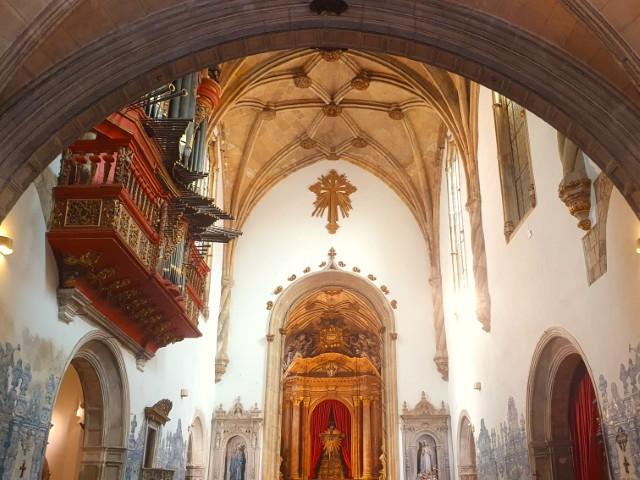
In the city’s shopping streets there are a few churches worth seeing.
Santa Cruz is particularly impressive.
I went inside to see some traditional Portuguese tiles. The walls are covered in painted tiles depicting stories from the past.
I learnt that people who couldn’t read would use the pictures to learn about Portuguese history.
The church also has a large and rather imposing Baroque organ.
This complex is one of Portugal’s most significant religious and historical sites.
Before the University of Coimbra was established, the monastery had been a well-known school.
This church-monastery houses the tombs of the first two Portuguese monarchs, Afonso Henriques and his son Sancho I, marking it as a national pantheon.
A boat trip in Coimbra
Taking a traditional boat trip in Coimbra on the Mondego River is a lovely activity for a sunny day or a special sunset experience.
You’ll see the city from the river, find out more about the history of the city, and also learn about the traditional Portuguese boat (moliceiro).
The Old Cathedral (Sé Velha)
A well preserved medieval cathedral, worth seeing for the beautiful architecture.
History buffs would love it too, it really takes you back in time once you step inside.
It’s an example of Romanesque architecture – an architectural style from the Middle Ages using elements from ancient Roman buildings.
It later developed into the Gothic style, which you’ll notice in the cloister.
The old cathedral looks like a fortress from the outside, and has some Moorish influences too in this building. I enjoyed the mix of styles and the flamboyance.
The New Cathedral (Sé Nova)
The New Cathedral isn’t actually new. It dates back to the late 16th century, which makes it relatively new compared to the medieval Old Cathedral.
I went there for the impressive decorations, the architecture, and to see the beautiful organ.
Once you step inside, expect to see golden altarpieces and intricate carvings. There are religious sculptures and paintings in the chapels.
It’s a little too dark inside, so it’s not ideal for photos, but still impressive to look at.
Go through the side door to reach a corridor with a small exhibition.
It’s part of the university complex, so you can visit both on the same day.
Monastery of Santa Clara

There are two monasteries of Santa Clara in Coimbra – the old and the new.
The old monastery was flooded many times by the river. The new one was built on top of the hill to replace it, high enough and far enough from the river to avoid floods.
What’s left of the old monastery are ruins with a visitor centre that tells the story of the monastery.
The new one has a richly decorated church you can visit.
In the courtyard before you enter you’ll see a statue of Queen Saint Isabel, founder of the monastery, whose tomb is inside.
In that outer courtyard, I found one of the best viewing points in the city. You can see the river, the University, the old town.
Inside, I enjoyed the flamboyant gilt carved woodwork. So much gold! Was my first reaction. It really makes you look up in awe.
I learnt that gilded woodcarving was a traditional Portuguese craft.
Move on to the cloisters and the inner courtyard and then in the next room there’s a small exhibition, and the original tomb of Queen Isabel, whose current tomb is in the main church hall.
There’s a QR code in each room that you can scan for a guide to learn more about the place.
Quinta das Lágrimas gardens

If you love gardens, visit Jardins da Quinta das Lágrimas, a lush and beautiful spot for a picturesque walk.
It’s known as the spot where the legend of Pedro and Inês (a local version of Romeo and Juliet, sort of) took place.
To reach the garden you have to enter via the golf club and pay a small entry fee at the counter. You can pick up a map there.
Then start your walk into the garden. The atmosphere became more and more magical as I walked down the path. I felt it was a perfect place to get lost in the moment.
It’s a lovely place to spend about 30 minutes of pure relaxation.
Museu Nacional de Machado de Castro
The Museu Nacional de Machado de Castro is one of Portugal’s finest art museums, housed in a former bishop’s palace.
You’ll see it as you climb up from the old town shopping street to the university.
Its collection includes Renaissance and Baroque art, the remarkably preserved Roman Cryptoporticus, religious art, medieval sculpture, and decorative arts.
Experiences unique to Coimbra
Other than the University of Coimbra, what are some experiences that are unique to the city?
When you plan a trip to Coimbra, aim to include some unique things to do in the city that you can’t do elsewhere.
Coimbra fado
Fado is a traditional musical genre in Portugal. You can hear fado in Lisbon too, but the Coimbra version is different in style.
I warmly recommend seeing a fado concert at Fado ao Centro in the historic centre of Coimbra.
It’s a venue designed for fado music, with daily concerts. The main advantage of these concerts is that you get explanations in English about the songs (sometimes with lyrics), about the history of fado music, and about local traditions connected to fado.
For me it was an educational experience and an entertaining evening in one.
Local food
Get to know the regional delicacies of Coimbra with a local food tour. Try some local wine, find authentic places to eat, and hear traditional stories behind each local dish.
Bissaya Barreto House Museum
This hidden gem was one of my favourite places in Coimbra. It seems a bit out of the way, but it’s actually very close to the university.
If you love art, architecture, and Portuguese tiles, visit the historic house of Bissaya Barreto to see his art collection, old furniture, and beautiful garden.
The owner of the house was a prominent figure in Coimbra’s history, who worked as a physician and became a wealthy philanthropist.
There’s a small fee to enter and you can ask for a guided tour in English.
Plan a trip to Coimbra with ready-made itineraries
I created itineraries to help you plan a trip to Coimbra, for a convenient day trip, a short city break, or a weekend trip.
1 day in Coimbra – all the essentials in one day.
2 days in Coimbra – the main highlights plus more attractions worth seeing.
You can stay even longer use Coimbra as a base for day trips.
Popular day trips from Coimbra
When you plan a trip to Coimbra, consider staying long enough to take a day trip or two.
The easiest day trips from Coimbra are:
Aveiro – The Portuguese Venice

You can reach Aveiro from Coimbra by train in about 45 minutes.
Why visit Aveiro? The “Venice of Portugal” has picturesque canals with colourful boats. Aveiro is also a great Art Nouveau architecture hub.
I’d recommend it to anyone who likes scenic water views (with many photo opportunities), a relaxing pace, and the charm of a smaller city.
You can also visit both cities in one day on a guided tour.
Figueira da Foz – The Queen of Portuguese Beaches
You can reach Figueira da Foz from Coimbra by train in about 40 minutes.
The “Queen of Portuguese Beaches” is a coastal resort town with sandy beaches and promenades. Great for sunbathing, swimming, and surfing.
This is a nice day trip for some sea and sun, a relaxed seaside vibe, a break from city life.
Conímbriga – An easy day trip to see Roman ruins
You can reach Conímbriga from Coimbra by bus in about 40 minutes or join a guided tour that includes transport and guidance.
It’s a classic day trip to see the best-preserved Roman archaeological sites in Portugal.
I’d recommend it to anyone who loves history, mosaics, and impressive Roman ruins, such as bathhouses and homes.
Schist Villages – the magical villages
A lovely day trip from Coimbra to historic villages and ancient castles. This one is a great option if you like history, nature, and architecture.
Visiting Coimbra and Aveiro in one day
You can visit both Coimbra and Aveiro on the same day.
Take a guided tour that covers both cities in one full day. It will take the load off when it comes to planning in advance and meeting schedules.
From Porto, take this Aveiro & Coimbra tour, a full day tour visiting both cities with hotel pickup and drop-off.
From Lisbon, take the Coimbra and Aveiro tour, a long day covering the main attractions in both cities.
It’s a good idea if you only have very limited time to spend in the Central region of Portugal. If you do have more time, I suggest you spend a bit longer in each city.
The history of Coimbra (in brief)
Coimbra has a rich history, combining Roman roots, royal legacy, and academic significance.
Its origins date back to Roman times, when it was known as Aeminium. You can actually wander through the underground Roman galleries beneath today’s Machado de Castro Museum.
In the Middle Ages Coimbra became the first capital of Portugal. Some of its monarchs are buried in the city.
The university, established in 1290, has attracted scholars and students for centuries and transformed the city into a cultural hub.
This was just a brief introduction. You’ll obviously learn more about the history of Coimbra when you tour the city.
How to get to Coimbra by public transport?

You can easily plan a trip to Coimbra by train or bus.
Buses are generally cheaper and some of them don’t take much longer than some of the trains.
There are several options, so I used Omio to compare prices and do a combined search of trains and buses.
To get to Coimbra from Porto, take the train from Campanhã station to Coimbra-B station. It takes just over an hour on the fastest train (called AP).
To get to Coimbra from Lisbon, take the train from Santa Apolónia or Oriente station to Coimbra-B station station. It takes about 1.5 hours.
As a general rule of thumb, it’s best to book as early as you can for lower prices and better seats. I do it as soon as I know my travel dates.
Reaching Coimbra from the airports
If you’re coming by plane, fly into Lisbon (LIS) or Porto (OPO) airports, take the metro into the city and then take a train or bus to Coimbra. There’s also a direct bus from Lisbon Airport.
For several people with luggage, it may make better sense to book a private transfer from the airport.
A personal tip on landing in Porto: My flight landed in Porto in the evening. Taking a train to Coimbra on the same evening would have been too much for one day. I booked a stay at an airport hotel in Porto for one night and took the train to Coimbra the next day. The hotel is a few minutes walk from the airport. It was nice and stress-free.
Visiting Coimbra on a day trip from Lisbon or Porto
If you’re based in Porto or Lisbon and want to see Coimbra without changing hotels, you can take a day trip to Coimbra.
Take an early train and spend a day sight seeing around the city. Use my 1 day itinerary to plan a day packed with all the essential Coimbra activities.
Alternatively, you can see Coimbra on a guided tour. There are several tours in Portugal that include Coimbra alongside other cities.
This is a good option if you’re short on time and want to see a couple of Portuguese cities in one day.
These tours give you a pre-planned route with a guide that will save you the effort of planning your trip to Coimbra independently.
Tours from Porto
Tours from Lisbon
- Aveiro and Coimbra
- Tomar and Coimbra
- Lisbon to Porto with stops in 3 cities (you can choose Coimbra as one of the stops)
How to get around Coimbra
Coimbra city centre is pedestrian-friendly. If you stay in the centre, it’s easy to get around on foot.
Most attractions and places to see are within walking distance of each other.
To reach Coimbra University, which is up a hill you can also take a bus or a taxi up there.
It’s possible to go uphill on foot if you don’t mind a steep climb that takes about 15 minutes, but you can take breaks along the way.
The public transport in Coimbra is fast and efficient. It includes local city buses and the fast Metrobus.
Check the SMTUC site for current fares.
Free things to do in Coimbra
I found some free things to do in Coimbra during my visit.
- Porta e Torre de Almedina – a small exhibition about the history of the city.
- The botanic gardens at the university.
- Santa Cruz Church – the main hall is free to visit.
- Judeus de Coimbra – an exhibition about the Jewish history of Coimbra.
- Sereia Garden – a magical garden.
- Edifício Chiado – the city gallery. The ground floor exhibition is free to visit.
- Take a self-guided tour in Coimbra
How many days to spend in Coimbra?
You can plan a trip to Coimbra for 1-3 days.
It’s not a very big city and the main attractions are within walking distance (or a short bus/taxi ride) from each other.
You can also see just the highlights in one day, for example on a day trip from Lisbon or Porto.
You can add an extra day or two and use it as a base for day trips without changing hotels.
What’s the best time to visit Coimbra ?

It’s best to plan a trip to Coimbra for the spring (March – May) or autumn (September – October).
The weather is mild and pleasant.
The summer months are hot and sunny, but beware of heatwaves. Students go on holiday in the summer, so much of the city’s unique vibe may be missing.
In winter you may be out of luck with too many rainy days.
I visited in late autumn and early winter. This is the less touristy season. I stayed long term to enjoy the local life and culture. The weather was cool and sometimes cold at night.
Next time, I’ll definitely visit in the spring. That’s the tip I got when talking to locals.
Save this guide on how to plan a trip to Coimbra on Pinterest


7 Comments
This is so helpful for planning a trip to Coimbra. The detail is fabulous . I think you provided more than a tour guide would. I think you got me on the monastery and a few other sites.
Such a helpful guide to Coimbra! I love that it combines the must-sees like the University and its beautiful Baroque library with gardens, riverside walks, Fado, and day-trip ideas. Coimbra sounds like a great choice for experiencing a slower, more relaxed side of Portugal.
We were certainly happy we planned a stop in Coimbra when we did a road trip in Portugal. But we only stayed one full day so we missed some of the great spots you planned. I guess this just means we need to visit again. Good to know we could use Coimbra as a base to visit Aveiro too!
Coimbra looks like a great city to enjoy for a few days. From wandering the historic streets and visiting its beautiful buildings to enjoying an evening of Coimbra Fado, your guide provides plenty of inspiration for planning a visit.
Wonderful guide and thorough..love the variety of activities and the idea of adding a few more days to make day trips…. Portugal is moving up on the must visit list.
I love to take walking tours when visiting a new place. The local perspective from the guide teaches you a lot more about the city than you would learn by just walking around yourself.
Thanks for sharing, Coimbra looks a lovely place to explore with lots to see and to do, the Roman ruins look a great place to visit 🙂